AS/RS Systems

Unit Load AS/RS

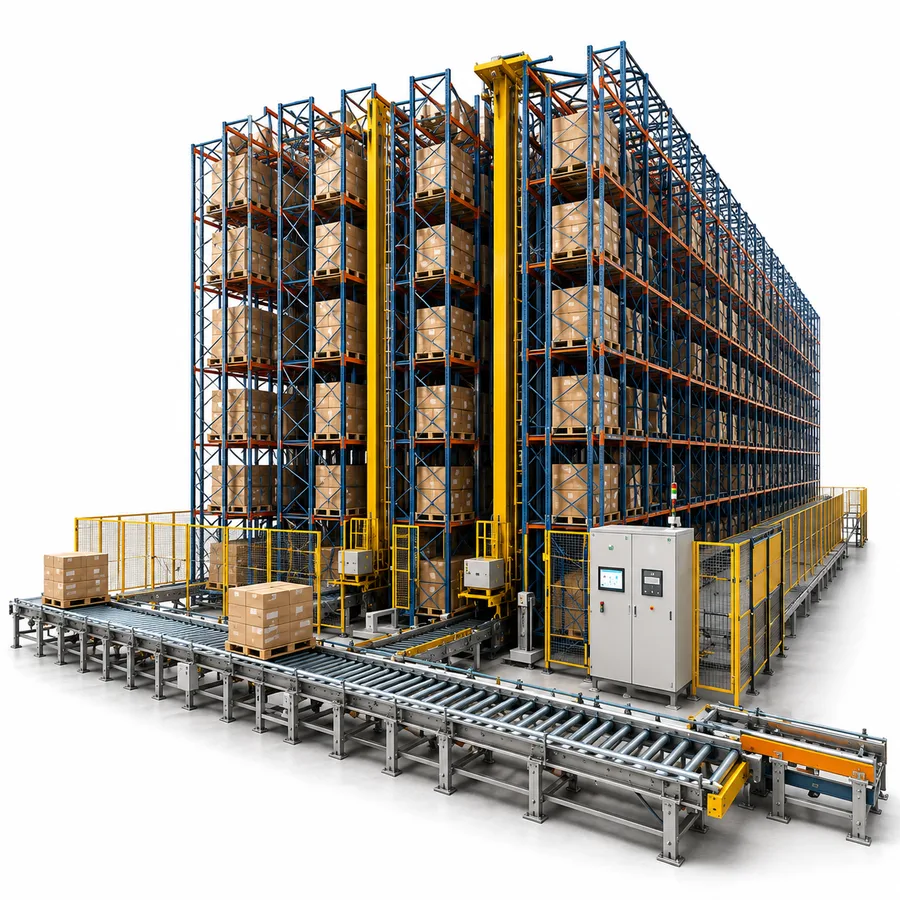
Pallet and heavy-unit automated storage using high-bay rack, stacker cranes and controlled infeed or outfeed points.

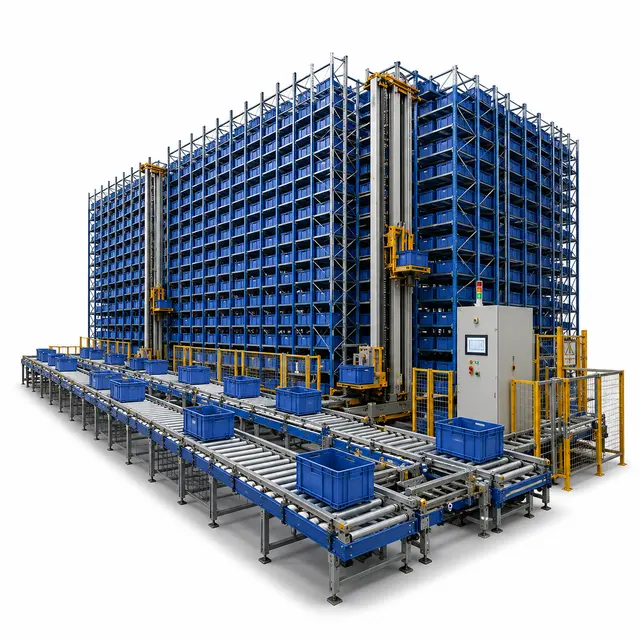
Illustrative configuration of Unit Load AS/RS.
Configuration illustration. Final design depends on the confirmed site, load and operating requirements.

Quick Answer

What is Unit Load AS/RS?

Unit Load AS/RS automates storage of pallets and other approved unit-load carriers in high-bay rack aisles. A stacker crane transfers each complete load between rack positions and conveyor, lift or transfer stations under warehouse controls. Feasibility depends on verified pallet and load data, stable unit geometry, inbound inspection, building and fire interfaces, conveyor routes, recovery access and a defined production or distribution flow.

Last reviewed:

Typical applications

Where This System Fits

  • Stable palletised inventory with verified carrier and load data.
  • High-bay storage linked to controlled conveyor entry and exit points.
  • Production buffers that track complete unit loads between processes.
  • Distribution or cold-store flows with disciplined pallet preparation.
  • Projects able to coordinate rack, crane, building, fire and controls interfaces.

Operating logic

How This Product Works

Review the operating principle, load movement and main configuration checkpoints before comparing a system for the application.

Pallet unit carriers

The system moves complete pallets or approved heavy carriers, making base quality, overhang, stability, wrapping and load geometry primary engineering inputs.

High-bay stacker crane

A crane serves tall rack aisles and transfers unit loads between storage positions and fixed conveyor, lift or transfer-car interfaces.

Conveyor buffer network

Inbound inspection, pallet queues, crane handoffs and outbound release points must be balanced with production, receiving and dispatch processes.

Building load inputs

Confirm pallet samples, maximum load data, rack envelope, slab, crane rails, fire strategy, controls, recovery zones and maintenance access.

Technical notes
  1. An inbound pallet or approved heavy carrier reaches a controlled station where identity, dimensions, stability and base condition can be checked before acceptance.
  2. Conveyors, lifts or transfer cars move the complete unit to the crane handoff. The high-bay stacker crane then travels along its aisle and deposits the load at an assigned rack position.
  3. Retrieval reverses that route to an outbound buffer, production feed, dispatch conveyor or another defined pallet interface. The process handles one unit load rather than presenting individual cartons for picking.
  4. Pallet and load data govern the mechanical design. Footprint, maximum mass, overhang, deflection, wrapping, centre of gravity and underside condition affect conveying, telescopic handling and clearances.
  5. The high-bay envelope must be coordinated with slab tolerances, crane rails, rack geometry, roof services, fire protection, maintenance areas, emergency access and any rack-clad building concept.
  6. WMS and WCS functions allocate locations, prioritise crane missions, track pallet identity and manage rejected or inaccessible loads. Recovery procedures should cover equipment faults and manual intervention.
  7. Inbound and outbound buffers must match upstream production or receiving and downstream dispatch demands; an automated aisle cannot correct uncontrolled pallet preparation outside its boundary.
  8. Unit-load automation is selected for pallets or comparable carriers. Tote and carton picking should be evaluated with mini-load, shuttle or goods-to-person equipment.

System strengths

Advantages

  • Automates the movement and location control of complete pallet unit loads.
  • Uses a high-bay crane aisle without routine forklift travel at every rack position.
  • Connects defined inbound and outbound pallet buffers through software missions.
  • Makes pallet inspection, conveyor transfer and recovery requirements explicit.
  • Supports production, cold-store or distribution storage when the surrounding flow is controlled.

Conditions to check

Limitations and Trade-Offs

  • Poor pallets, overhanging loads or unstable wrapping can be rejected before storage.
  • High-bay rack, crane rails, conveyors, controls and fire systems require coordinated engineering.
  • Upstream preparation or downstream congestion can restrict the automated aisle.
  • Final load limits, mission rates and capacity depend on confirmed equipment and building data.

Configuration brief

Technical specifications available on request

Final specifications for Unit Load AS/RS are confirmed from the actual load, site and operating requirements.

  • Pallet or unit-carrier footprint, underside, maximum mass and representative load samples.
  • Load overhang, centre of gravity, wrapping, deflection and stability acceptance.
  • Storage quantity, inbound pallet profile, outbound demand and buffer sizing.
  • High-bay envelope, aisle length, slab tolerance, crane rails and roof services.
  • Fire strategy, rack-clad boundary if applicable and emergency routes.
  • Conveyor, lift, transfer-car, production, receiving and dispatch interfaces.
  • WMS/WCS messages, pallet identification, rejection, recovery and maintenance access.

Standards and compliance

Applicable Standards and Project Requirements

RUNDA RACK products are designed, manufactured, supplied and installed in accordance with applicable international standards, project specifications and destination-market requirements. The engineering package aligns the product family, load data, site conditions, fire strategy, equipment interfaces and required documentation.

Review the standards framework →

EN 528

Rail-dependent storage and retrieval equipment — Safety requirements for S/R machines

2021Authoritative source ↗

Practical comparison

Compare Common Alternatives

Mini Load AS/RS
Unit Load AS/RS handles pallets or heavy carriers; Mini Load AS/RS handles totes, trays and cases.
Multi-Shuttle AS/RS
Multi-shuttle systems use many small vehicles for tote or carton buffering, while unit-load systems use pallet cranes.
Rack-Clad Warehouse
Rack-clad is a building-structure concept; in a rack-clad unit-load AS/RS, the rack supports both the storage system and the enclosure loads.

Configuration inputs

What to Confirm Before Selection

  • Pallet or unit-carrier footprint, underside, maximum mass and representative load samples.
  • Load overhang, centre of gravity, wrapping, deflection and stability acceptance.
  • Storage quantity, inbound pallet profile, outbound demand and buffer sizing.
  • High-bay envelope, aisle length, slab tolerance, crane rails and roof services.
  • Fire strategy, rack-clad boundary if applicable and emergency routes.
  • Conveyor, lift, transfer-car, production, receiving and dispatch interfaces.
  • WMS/WCS messages, pallet identification, rejection, recovery and maintenance access.

Product questions

Frequently Asked Questions

What does Unit Load AS/RS handle?
It handles complete pallets or other approved heavy unit-load carriers rather than individual totes, cartons or loose small parts.
Which pallet data is required?
Confirm footprint, underside, maximum mass, overhang, deflection, wrapping, centre of gravity, stability and the acceptance limits used at inbound inspection.
How does the crane connect to the warehouse?
Conveyors, lifts, transfer cars or fixed handoff stations link the high-bay aisle to receiving, production, buffers and dispatch.
Which building inputs affect feasibility?
Clear envelope, slab tolerance, crane rails, rack geometry, fire protection, roof services, maintenance zones and emergency access all require coordination.

Planning resources

Continue Product Planning

Configuration

Discuss the Checked Application

Share the product, site and handling details needed for a suitable configuration.
WhatsAppEmail