Pallet Racking

Push Back Racking

Cart-based lane storage for grouped pallets retrieved from the same face.

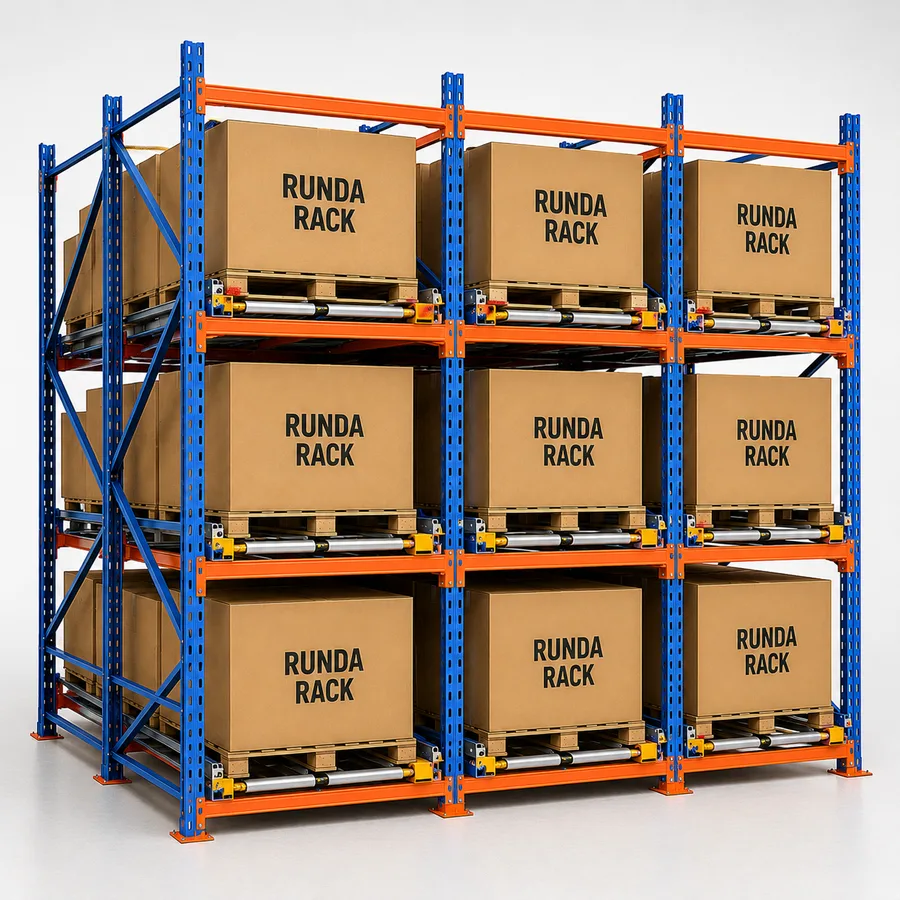
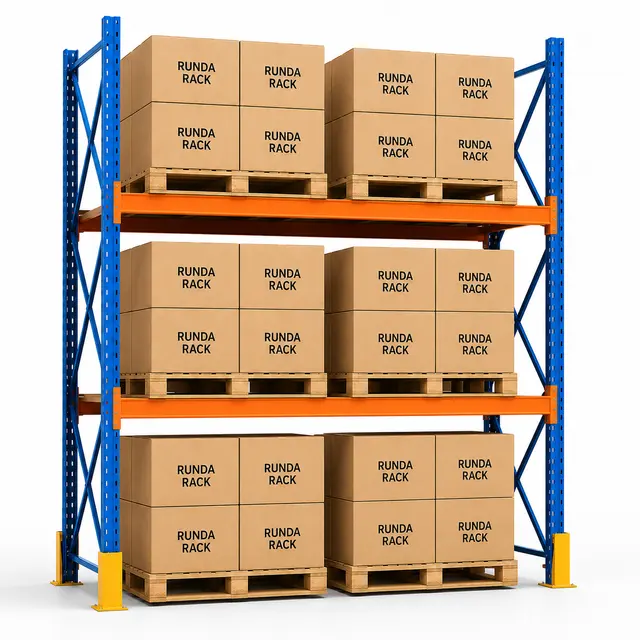
Illustrative configuration of Push Back Racking.
Configuration illustration. Final design depends on the confirmed site, load and operating requirements.

Quick Answer

What is Push Back Racking?

Push Back Racking stores a limited number of pallets in an inclined lane using nested carts or a guided rolling surface. The forklift stays in the aisle: each new load pushes the earlier carts rearward, and gravity presents the next pallet after retrieval. Because both actions use one face, the sequence is LIFO. Pallet bases, cart travel, stops and load stability require confirmation.

Last reviewed:

Typical applications

Where This System Fits

  • Several pallets per SKU with acceptable last-in, first-out rotation.
  • Compact storage where forklifts should remain in the working aisle.
  • Repeated batches that fit the available nested-cart depth.
  • Stable pallets with undersides compatible with the selected moving platform.
  • Operations able to inspect rails, carts, stops and visual indicators.

Operating logic

How This Product Works

Review the operating principle, load movement and main configuration checkpoints before comparing a system for the application.

Inclined cart stack

Nested carts separate as pallets are added, travelling rearward on sloped rails while the forklift remains at the front aisle position.

Gravity return motion

Removing the face pallet lets the next occupied cart roll forward to the stop, ready for retrieval without truck entry into the lane.

Finite LIFO depth

The cart count defines a limited number of positions, and the last pallet placed into that channel becomes the first available load.

Moving hardware checks

Confirm pallet underside, cart compatibility, rail condition, braking, front stops, load stability, operator visibility and inspection access before layout approval.

Technical notes
  1. Nested carts sit on inclined rails at the aisle face. The first pallet is placed on the exposed front cart; each later pallet pushes the occupied carts rearward and exposes the next cart position for loading.
  2. During retrieval, the forklift removes the front load and the remaining carts roll toward the pick face under controlled gravity. Braking, stops and operator technique keep that return movement predictable.
  3. The truck does not travel down the storage lane. All handling occurs at the aisle edge, which distinguishes push-back from drive-in and drive-through rack tunnels.
  4. One face serves both loading and removal, so the newest pallet leaves first. Product families assigned to a lane must accept LIFO and should not mix stock with conflicting expiry or release rules.
  5. Practical depth is constrained by the cart stack or rolling-lane design. The available number of pallet positions should match repeat batch quantities rather than an unlimited deep-lane assumption.
  6. Actual pallet undersides must engage the cart or rails correctly. Broken boards, inconsistent runners, excessive overhang or unstable wrapping can prevent a clean return to the face.
  7. Front stops, cart alignment, rail cleanliness and visual indicators need routine inspection because the moving hardware carries every stored load.
  8. Operators should place and push pallets smoothly from the aisle, watch the exposed cart position and avoid impact loading that can disturb the nested mechanism.
  9. Push-back suits grouped stock requiring more density than selective rack without sending forklifts between the frames.

System strengths

Advantages

  • Increases pallet depth without requiring the forklift to enter a rack tunnel.
  • Presents the next available load automatically at the aisle face.
  • Uses one working aisle for both placement and retrieval.
  • Keeps each lane available to a separate product group within the designed cart count.

Conditions to check

Limitations and Trade-Offs

  • Same-face operation means strict FIFO cannot be achieved within the lane.
  • Moving carts, rails and stops add inspection and maintenance points.
  • Pallet-base variation can interrupt travel even when the overall load remains within an engineered range.
  • Lane depth is limited by the selected mechanism; when the required batch quantity exceeds that depth, select another dense-storage method.

Configuration brief

Technical specifications available on request

Final specifications for Push Back Racking are confirmed from the actual load, site and operating requirements.

  • Pallet underside, runner orientation, footprint, load stability and weight range.
  • Pallets per SKU and the nested-cart depth required for each batch.
  • Acceptance of one-face LIFO rotation and front-pallet identification.
  • Forklift approach height, aisle clearance and controlled push technique.
  • Cart type, rail slope, braking method, front stops and return indicators.
  • Cleaning, inspection and maintenance access for the moving lane components.
  • Rack protection, fire requirements and emergency access around the aisle face.

Standards and compliance

Applicable Standards and Project Requirements

RUNDA RACK products are designed, manufactured, supplied and installed in accordance with applicable international standards, project specifications and destination-market requirements. The engineering package aligns the product family, load data, site conditions, fire strategy, equipment interfaces and required documentation.

Review the standards framework →

Practical comparison

Compare Common Alternatives

Drive-In Racking
Both are compact and often LIFO, but push back does not require forklift entry.
Pallet Flow Racking
Pallet flow is two-face FIFO; push back is one-face LIFO on carts or rollers.
Double Deep Racking
Double deep is a simpler front-and-rear pair; push back uses moving lanes for deeper same-face storage.

Configuration inputs

What to Confirm Before Selection

  • Pallet underside, runner orientation, footprint, load stability and weight range.
  • Pallets per SKU and the nested-cart depth required for each batch.
  • Acceptance of one-face LIFO rotation and front-pallet identification.
  • Forklift approach height, aisle clearance and controlled push technique.
  • Cart type, rail slope, braking method, front stops and return indicators.
  • Cleaning, inspection and maintenance access for the moving lane components.
  • Rack protection, fire requirements and emergency access around the aisle face.

Product questions

Frequently Asked Questions

Does a forklift enter Push Back Racking?
No. The forklift handles every pallet from the aisle face while nested carts or a guided rolling lane move stored loads within the rack.
Why does Push Back Racking use LIFO?
New pallets push earlier loads behind them, and retrieval starts with the front position. The latest stored pallet is therefore removed first.
What limits a Push Back lane depth?
Depth depends on the selected cart stack or rolling mechanism, its engineered travel and the number of compatible pallets assigned to the channel.
Why must the pallet underside be checked?
The base contacts moving carts or rails. Damaged or inconsistent boards can obstruct travel, affect presentation at the stop or destabilise the load.

Planning resources

Continue Product Planning

Configuration

Discuss the Checked Application

Share the product, site and handling details needed for a suitable configuration.
WhatsAppEmail