Specialty Storage

Mobile Shelving

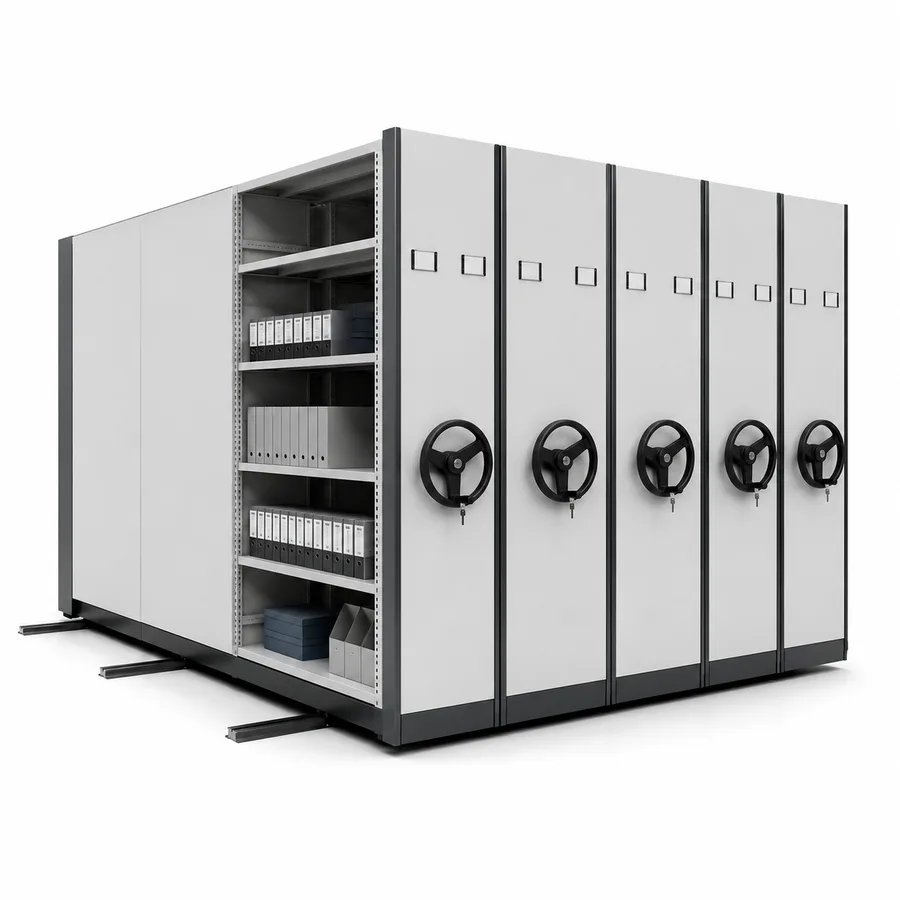
Compact movable-aisle shelving for archives, parts rooms and low-frequency hand-accessed storage.

Illustrative configuration of Mobile Shelving.
Configuration illustration. Final design depends on the confirmed site, load and operating requirements.

Quick Answer

What is Mobile Shelving?

Mobile Shelving is a compact storage system where shelving runs sit on movable bases or carriages so staff open only the aisle they need. It is best suited to hand-accessed items such as records, parts, tools or boxed inventory with moderate access frequency. The main checks are floor condition, track or base type, aisle opening, item weight, safety controls and simultaneous user needs.

Last reviewed:

Typical applications

Where This System Fits

  • Archive and records storage.
  • Maintenance parts rooms.
  • Tool stores and controlled stockrooms.
  • Low-to-moderate access hand-loaded items.
  • Facilities trying to compact fixed shelving without moving to pallet storage.

Operating logic

How This Product Works

Review the operating principle, load movement and main configuration checkpoints before comparing a system for the application.

Compact movable aisles

Mobile shelving mounts shelf runs on movable bases, so low-frequency storage can use one opening aisle instead of many fixed aisles.

Archive item interface

Files, parts or boxed inventory should be checked for shelf depth, load per level, access frequency and whether dust control is needed.

Controlled access flow

Users move the shelf run to open an aisle, retrieve items, then close the system to keep storage dense and organised.

Mobile shelving inputs

Confirm room size, floor condition, shelf load, item dimensions, access frequency, security needs, handle type and aisle width.

Technical notes
  1. Conventional fixed shelving keeps an aisle open between many rows. Mobile shelving reduces fixed aisle demand by placing rows on movable bases, allowing one or more access aisles to be opened where needed. This makes the product fundamentally different from mobile pallet racking, which is designed around forklift-handled pallet loads.
  2. The suitability depends on access pattern. Archives, records, spare parts, maintenance tools and slow-moving boxed stock can work well when users can wait for an aisle to open. For very fast picking zones with many people needing different aisles at the same time, compare fixed shelving or a pick module instead.
  3. Floor and base details must be confirmed early. Tracks, raised floors, guide rails, levelness, slab capacity and transition ramps can affect installation and usability. Not every room can accept mobile shelving without floor preparation.
  4. The stored-item profile matters. Files, cartons, plastic bins, maintenance spares and small tools need different shelf depths, dividers, labels and security requirements. A good quote request includes item dimensions, approximate shelf loads, number of users and whether the storage is open, lockable or controlled.
  5. Safety and operation should be part of the enquiry. The project scope determines whether movement is manual, mechanical-assist or powered, so the required method must be confirmed. Review aisle locks, anti-tip measures and user procedures against the selected movement system and layout.
  6. Mobile shelving is intended for hand-loaded compact storage. Mobile pallet racking serves pallet positions and forklift access, so the two systems require different floor, load, movement and safety inputs.

System strengths

Advantages

  • Reduces permanent aisle space compared with fixed shelving layouts.
  • Keeps stored items hand accessible when the right aisle is opened.
  • Provides a clear alternative to ordinary shelving for compact rooms.
  • Separates hand-loaded compact shelving from forklift-served mobile pallet racking.
  • Encourages buyers to confirm floor, track, user and access-frequency details.

Conditions to check

Limitations and Trade-Offs

  • Not ideal for many users needing many aisles open at the same time.
  • Floor levelness, track or base installation and slab condition affect feasibility.
  • Not intended for forklift-handled pallet loads.
  • Movement type and safety controls must be confirmed for each project.

Configuration brief

Technical specifications available on request

Final specifications for Mobile Shelving are confirmed from the actual load, site and operating requirements.

  • Room dimensions, door positions and available clear height.
  • Stored item type, dimensions and approximate shelf loads.
  • Required aisle width and number of simultaneous users.
  • Access frequency by item group.
  • Floor levelness, slab condition and track or base preference.
  • Security, labelling, divider and lock requirements.

Standards and compliance

Applicable Standards and Project Requirements

RUNDA RACK products are designed, manufactured, supplied and installed in accordance with applicable international standards, project specifications and destination-market requirements. The engineering package aligns the product family, load data, site conditions, fire strategy, equipment interfaces and required documentation.

Review the standards framework →

Practical comparison

Compare Common Alternatives

Mobile Pallet Racking
Mobile pallet racking is for pallet positions and forklift aisles; mobile shelving is for hand-accessed shelving rows.
Boltless Shelving
Boltless shelving is fixed and simple; mobile shelving adds movable bases to reduce permanent aisles.
Parts Bin Shelving
Parts-bin shelving organises small items in fixed bays or within a compact mobile-storage room.

Configuration inputs

What to Confirm Before Selection

  • Room dimensions, door positions and available clear height.
  • Stored item type, dimensions and approximate shelf loads.
  • Required aisle width and number of simultaneous users.
  • Access frequency by item group.
  • Floor levelness, slab condition and track or base preference.
  • Security, labelling, divider and lock requirements.

Product questions

Frequently Asked Questions

What is mobile shelving?
Mobile shelving uses movable bases or carriages so staff open only the aisle they need for hand-accessed storage.
Is it the same as mobile pallet racking?
No. Mobile shelving is for hand-loaded items, while mobile pallet racking is for forklift-handled pallet storage.
What should be checked first?
Check room size, floor condition, track or base approach, item weight, access frequency, aisle width and number of simultaneous users.

Planning resources

Continue Product Planning

Configuration

Discuss the Checked Application

Share the product, site and handling details needed for a suitable configuration.
WhatsAppEmail