Specialty Storage

Mold and Die Storage Rack

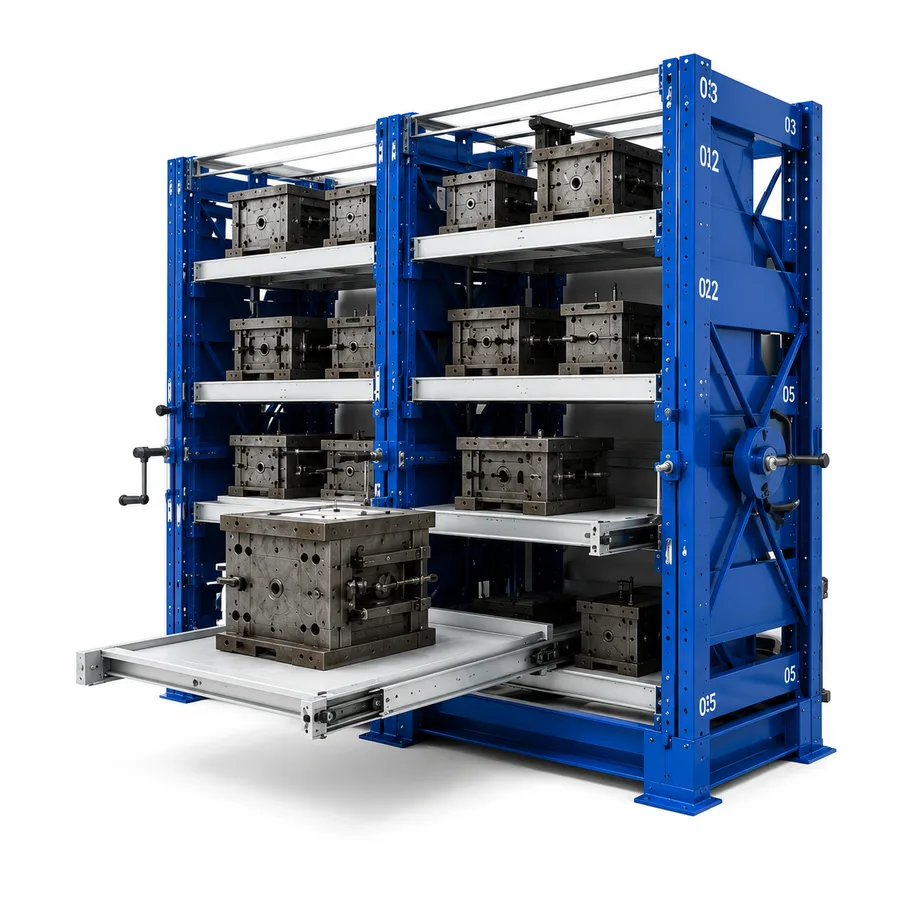
Heavy tooling storage for molds, dies and fixtures with handling access planned around crane, forklift or roll-out requirements.

Illustrative configuration of Mold and Die Storage Rack.
Configuration illustration. Final design depends on the confirmed site, load and operating requirements.

Quick Answer

What is Mold and Die Storage Rack?

A Mold and Die Storage Rack is a heavy-duty tooling storage solution for molds, dies, fixtures and similar dense components. Select crane access, forklift pockets, fixed shelves, rollers or pull-out shelves from the actual tooling and handling method instead of assuming a configuration from a generic rack image. Document the selected handling interface in the project scope.

Last reviewed:

Typical applications

Where This System Fits

  • Injection molds, press dies, fixtures and heavy tooling.
  • Manufacturing plants needing organised die or mold positions.
  • Facilities using cranes, forklifts, die carts or controlled pull-out access.
  • Toolrooms where ordinary pallet racking does not fit the retrieval method.
  • Buyers who can provide dimensions, weights and handling details.

Operating logic

How This Product Works

Review the operating principle, load movement and main configuration checkpoints before comparing a system for the application.

Tooling storage bays

Mold and die racks create defined storage positions for heavy tooling, fixtures and dies that need controlled handling access.

Heavy tooling interface

Tool weight, base shape, lifting points and centre of gravity decide whether shelves, pull-out decks or handling aids are required.

Crane forklift access

The rack must match the actual crane, forklift or roll-out method so tooling can be moved without improvised lifting routes.

Tooling rack inputs

Confirm mold dimensions, weight range, lifting method, access frequency, shelf style, floor condition, safety locks and maintenance clearance.

Technical notes
  1. Molds and dies are dense, valuable and often difficult to handle manually. Storage must be planned around the tooling envelope, weight, centre of gravity, lifting points and retrieval method rather than selected as a standard shelf.
  2. Handling access is the first decision. Some facilities use overhead cranes, forklifts or die carts, while others need pull-out or roll-out shelves. Confirm whether the required mechanism is a fixed cell, roller interface or controlled pull-out shelf before configuration.
  3. Shelf and cell dimensions should be based on actual molds or dies. Height clearance, width, depth, overhang, support points and die stop requirements can affect the rack. Generic public load ratings are risky because tooling loads are highly concentrated and create point loads wherever the support area is localised rather than evenly distributed.
  4. Safety details include retention, stops, shelf movement control, guarding, aisle clearance and loading procedure. Where die carts, crane hooks, slings, fork entry or maintenance access are used, the rack must coordinate with those interfaces. Capture them before quoting.
  5. Unlike pallet racking for palletised goods, mold and die storage is configured around tooling support points, concentrated loads and the selected retrieval method.
  6. Provide a tooling list, maximum dimensions, maximum weight, number of storage positions, handling equipment, loading direction, required shelf movement and photos of the area. These inputs allow the rack configuration and handling interfaces to be checked before quotation.

System strengths

Advantages

  • Focuses on tooling handling rather than generic storage-rack wording.
  • Supports crane, forklift, die-cart or roll-out configuration discussion without overclaiming.
  • Encourages exact mold and die data before quotation.
  • Differentiates clearly from pallet racking, sheet metal racks and general specialty storage.
  • Avoids unsupported capacity values while still explaining the right engineering questions.

Conditions to check

Limitations and Trade-Offs

  • Requires accurate tool weight and dimension data before design.
  • Handling method affects the rack mechanism and cost.
  • Point loads, stops and shelf movement require project-specific review.
  • Not intended as a generic rack for mixed light inventory.

Configuration brief

Technical specifications available on request

Final specifications for Mold and Die Storage Rack are confirmed from the actual load, site and operating requirements.

  • Tooling list with dimensions and maximum weight.
  • Number of molds, dies or fixtures to store.
  • Handling method: crane, forklift, die cart, fixed shelf, roller or pull-out access.
  • Loading direction, aisle clearance and lifting points.
  • Required stops, retention, shelf movement and safety controls.
  • Floor condition, installation area and future tooling changes.

Standards and compliance

Applicable Standards and Project Requirements

RUNDA RACK products are designed, manufactured, supplied and installed in accordance with applicable international standards, project specifications and destination-market requirements. The engineering package aligns the product family, load data, site conditions, fire strategy, equipment interfaces and required documentation.

Review the standards framework →

Practical comparison

Compare Common Alternatives

Sheet Metal Storage Rack
Sheet metal racks support flat sheet handling; mold and die racks support dense tooling with different load and retrieval concerns.
Coil Storage Rack
Coil racks restrain cylindrical coils; mold and die racks store block-like tooling, dies or fixtures.
Selective Pallet Racking
Selective pallet racking stores palletised loads; mold and die storage requires tooling-specific support and handling checks.

Configuration inputs

What to Confirm Before Selection

  • Tooling list with dimensions and maximum weight.
  • Number of molds, dies or fixtures to store.
  • Handling method: crane, forklift, die cart, fixed shelf, roller or pull-out access.
  • Loading direction, aisle clearance and lifting points.
  • Required stops, retention, shelf movement and safety controls.
  • Floor condition, installation area and future tooling changes.

Product questions

Frequently Asked Questions

What is a mold and die storage rack?
It is a tooling storage rack for molds, dies, fixtures and dense components that require controlled handling and support.
Are pull-out shelves always included?
No. Pull-out, roller, fixed-cell, crane or forklift access should be treated as configuration choices until the tooling and handling method are confirmed.
What information is needed?
Provide tooling dimensions, maximum weight, number of positions, loading direction, lifting method, aisle clearance and required stops or retention.

Planning resources

Continue Product Planning

Configuration

Discuss the Checked Application

Share the product, site and handling details needed for a suitable configuration.
WhatsAppEmail