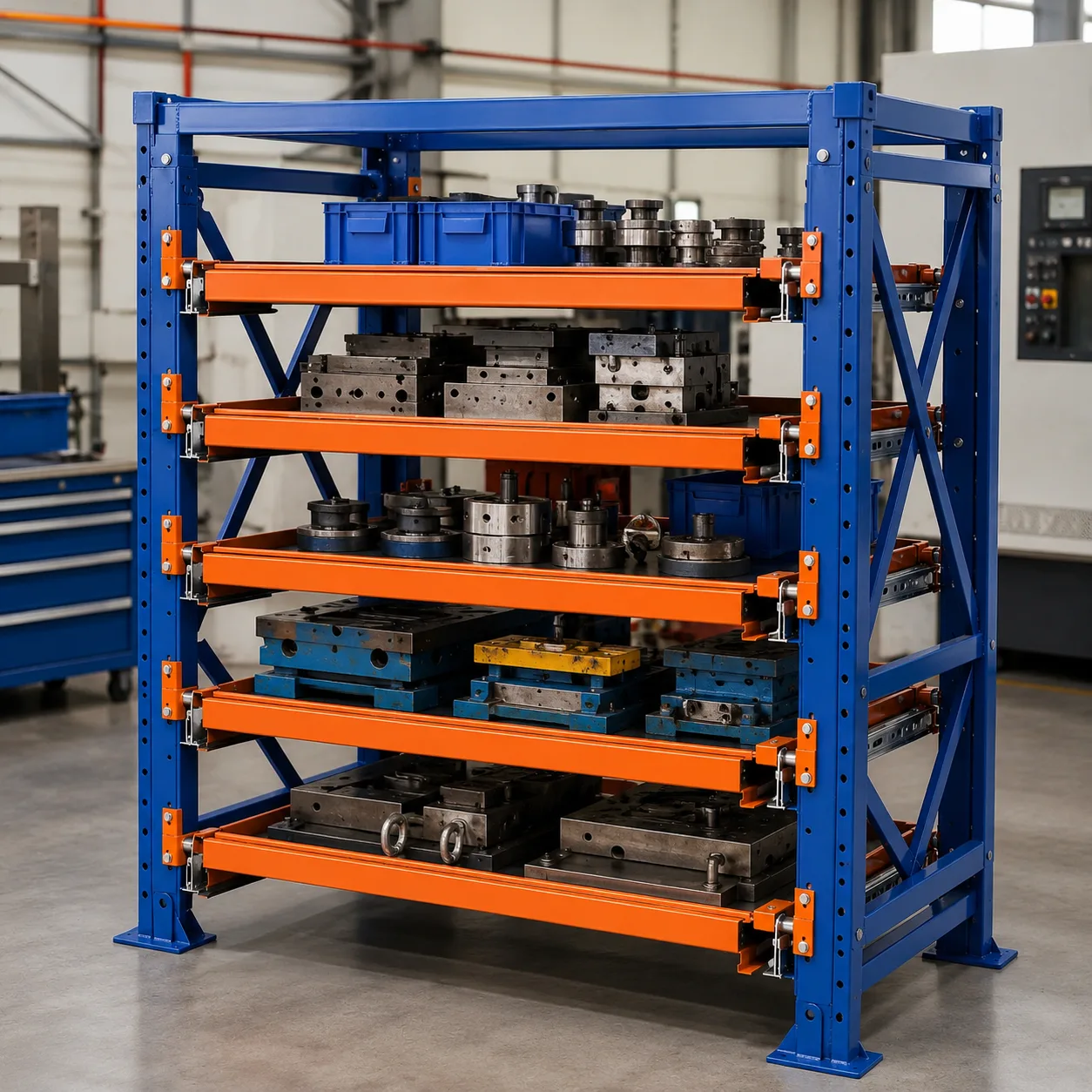
Heavy-Duty Drawer Mold Rack
Specialized storage for precision molds and industrial heavyweights, featuring full-extension slides for maximum safety and rapid access.
Technical Specifications
Global Shipping & Installation Available
Why This Solution?
- Optimized for high-traffic environments
- Premium finishes that enhance product value
- Rapid 24/7 global technical support
Core Technology & Applications
Heavy-Duty Drawer Mold Racks: Engineering Precision in Industrial Storage
In the world of high-volume manufacturing, such as injection molding, metal stamping, and die-casting, the mold is the most valuable asset in the facility. These precision-engineered tools often cost tens of thousands of dollars and weigh several tons. Storing them on standard racking or on the floor is not only inefficient but dangerous. The Runda Heavy-Duty Drawer Mold Rack is a specialized structural solution designed to manage these massive assets with the precision of a laboratory and the strength of a fortress. This guide explores the engineering intricacies that make our drawer-style systems the gold standard for modern industrial plants.
1. Context: The Strategic Value of Efficient Mold Management
Lean manufacturing and Just-In-Time (JIT) production require rapid tool changeovers. Every minute spent searching for a mold or waiting for a forklift to move obstructions is lost revenue. By utilizing a drawer-style system, manufacturers can store their entire mold inventory in a high-density vertical format while maintaining 100% immediate access to every single tool. This organization reduces the ‘Single-Minute Exchange of Die’ (SMED) time, directly increasing machine uptime and overall plant profitability.
2. Structural Engineering: The Mechanics of Extreme Cantilever Loads
When a drawer carrying 2,000kg is fully extended, it creates a massive cantilever force that attempts to rotate the entire rack forward. Engineering for this force is what separates a Runda rack from standard shelving.
Structural Channel Steel Construction
Unlike light-duty racks made from folded sheet metal, our mold racks are constructed from hot-rolled structural channel steel. This material provides the high section modulus required to resist bending and twisting under extreme eccentric loads. The frames are vertically braced and precision-welded to create a rigid ‘cage’ that maintains its alignment even after years of supporting multi-ton loads.
The Bearing Slide Assembly
The heart of the system is the bearing assembly. We utilize oversized, hardened steel rollers that run on precision-ground tracks. These bearings are designed to handle high Hertzian contact stresses, ensuring they do not develop ‘flat spots’ when the drawer is left loaded for long periods. The slide geometry is designed for ‘over-travel,’ allowing the mold to be completely clear of the rack frame so that a crane can lift it vertically without obstruction.
The Interlock Safety System
To prevent a catastrophic forward tip-over, we integrate a mechanical interlock. This system uses a vertical locking bar that is triggered by the movement of any single drawer. Once one drawer is opened by even a few centimeters, the bar drops, preventing any other drawer in that bay from being moved. This ensures that the rack’s center of gravity always remains safely within its supported base.
3. Material Science: Durability in Harsh Environments
Factories are harsh environments characterized by metal dust, oil mists, and temperature fluctuations.
- High-Tensile Carbon Steel: We use grades that offer superior fatigue resistance, ensuring the drawer tracks can handle thousands of cycles without work-hardening or cracking.
- Industrial Epoxy Coating: The steel is treated with a high-build epoxy powder coating. This finish is significantly thicker than standard paint and is designed to resist the ‘impact chipping’ caused by heavy chains, hooks, and metal mold bases.
- Precision Bearings: Our bearings are sealed and pre-lubricated with high-pressure grease, protecting the internal rolling elements from the abrasive grit common in metalworking shops.
4. ROI: Beyond Simple Storage
The return on investment for a drawer mold rack is calculated across three primary areas:
- Mold Protection: Molds are frequently damaged when being moved by forklifts or when stored in damp floor-level areas. Drawer racks keep molds off the floor and provide a stable, protected environment, significantly extending the life of these expensive assets.
- Floor Space Optimization: By storing molds vertically, you can free up hundreds of square meters of floor space for new production machinery. In many cases, the value of the reclaimed floor space exceeds the cost of the racking system within the first year.
- Worker Ergonomics: Manually moving heavy molds is a leading cause of back injuries. The effortless glide of our drawers and the integrated crane rails allow operators to handle multi-ton loads with minimal physical effort, reducing workers’ compensation claims and improving morale.
5. Safety: A Comprehensive Ecosystem
Safety is not an ‘add-on’ feature; it is the foundation of our design.
Integrated Lifting Systems
By including an I-beam crane rail at the top of the rack, we ensure that every lift is a ‘clean lift.’ Operators can position the hoist directly over the mold’s center of gravity. This eliminates the ‘swinging’ that occurs when a distant bridge crane is used, protecting both the staff and the delicate mold faces.
Safety Locking Pins
In addition to the interlock system, every drawer is fitted with a secondary manual locking pin. This pin must be engaged when the drawer is closed, providing a redundant safety layer that prevents drawers from sliding open during seismic events or accidental impacts.
6. Installation and Maintenance: Precision is Key
A mold rack must be perfectly level to operate safely. If the rack leans forward, the drawers may slide open on their own; if it leans back, they will be difficult to pull out.
- Laser-Guided Leveling: During installation, we use high-precision laser levels to ensure the tracks are horizontal to within 0.5mm per meter. We use heavy-duty steel shims under the base plates to compensate for any floor irregularities.
- Chemical Anchoring: For maximum security, we recommend chemical anchors that bond the bolts to the concrete, providing superior vibration resistance compared to standard mechanical expansion bolts.
- Predictive Maintenance: We provide a maintenance logbook that guides your team through the simple process of cleaning and lubricating the tracks, ensuring your rack continues to provide a ‘smooth’ experience for decades.
By choosing the Runda Heavy-Duty Drawer Mold Rack, you are investing in a system that respects the value of your precision tools and the safety of your personnel. It is the definitive solution for manufacturers who refuse to compromise on industrial excellence.
Core Technology Excellence
High-Precision Bearing Slides
Industrial-grade heavy-duty rollers ensure smooth, effortless operation even under a 3-ton load, significantly reducing manual effort and risk of injury.
Anti-Tip Interlock Safety
Patented mechanical safety system ensures only one drawer is accessible at a time, physically preventing tipping hazards caused by shifted weight.
Integrated Lifting Rail
The top frame is designed to support I-beam crane rails and hoists (up to 3 tons), creating a complete workstation for mold storage and maintenance.
Welded Channel Steel Frame
The primary structure is welded from heavy-duty channel steel, offering 50% more torsional rigidity than modular assemblies for the toughest factory floors.
Industry Applications
Injection & Stamping Shops
Secure management of precision dies, extending tool life and drastically shortening changeover times.
Heavy Assembly Lines
Organized storage for large motors, gearboxes, and critical production jigs, keeping the workspace clutter-free.
R&D and Prototyping
Providing categorized, accessible storage for experimental molds that require frequent switching.
Project FAQ
Q: How does the anti-tip interlock mechanism physically work?
A: The anti-tip interlock is a mechanical linkage system that connects all drawers within a single bay. When a specific drawer is pulled out, the linkage engages a locking bar on all other levels, physically preventing them from being moved. This ensures that the center of gravity of the rack remains within the footprint of the base. This is a critical safety feature that prevents catastrophic tip-over accidents caused by human error or multiple drawers being opened simultaneously.
Q: What is the maintenance schedule for the heavy-duty bearing slides?
A: Because our mold racks operate in industrial environments with dust and metal shavings, we recommend a quarterly inspection of the bearing tracks. This involves cleaning any debris from the rails and applying high-pressure lithium grease to the heavy-duty bearings. If the drawers are operated frequently (more than 10 times per day), we recommend monthly lubrication to ensure the smooth, one-handed operation that Runda racks are known for.
Q: Can the drawer height be adjusted to accommodate different mold sizes?
A: Yes, our mold racks feature a modular upright system where the drawer levels can be adjusted in increments of 50mm or 100mm. This allows you to optimize the rack's vertical space by placing thinner dies at the bottom and taller molds in the middle levels. Adjustment requires a forklift to support the weight of the empty drawer unit during the reconfiguration process.
Q: Is it possible to install an electric hoist on the integrated top rail?
A: Absolutely. The top frame of the Runda Mold Rack is engineered as a structural I-beam capable of supporting both manual and electric hoists. We provide pre-drilled mounting points and end-stops for the crane trolley. For electric hoists, we can also integrate cable management tracks (festoon systems) to ensure that power cables do not interfere with the movement of the molds.
Q: How do you protect the precision surfaces of the molds from being scratched by the steel drawers?
A: We offer several surface protection options. The standard option is a 3mm thick oil-resistant rubber mat that provides both cushioning and friction to prevent the mold from sliding. For ultra-precision medical or electronics molds, we can provide high-density polyethylene (HDPE) or hardwood inserts that are soft enough to prevent scratching while still being durable enough to handle multi-ton loads.
Q: What are the floor anchoring requirements for a 10-bay mold rack installation?
A: Each upright base plate must be secured using two M16 high-expansion bolts or chemical anchors with a minimum embedment depth of 120mm. Given that a fully loaded rack can weigh over 20 tons, the concrete floor must be at least 200mm thick and reinforced. We provide a detailed floor loading map to your facility manager prior to installation to ensure your slab can handle the concentrated point loads.
Q: Are these racks suitable for 'Clean Room' environments used in medical molding?
A: Yes, for clean room applications, we manufacture the racks using stainless steel or with a specialized non-shedding powder coating. We also replace the standard grease-lubricated bearings with sealed, dry-lubricated precision rollers to prevent any risk of lubricant contamination in the sterile environment.