Automated Warehouse System (AS/RS)
Advanced AS/RS solutions integrating robotics and WMS for maximum space utilization and zero-error logistics.
Technical Specifications
Global Shipping & Installation Available
Why This Solution?
- Optimized for high-traffic environments
- Premium finishes that enhance product value
- Rapid 24/7 global technical support
Core Technology & Applications
Technical Guide to Automated Storage and Retrieval Systems (AS/RS)
The Runda AS/RS is more than just racking—it is digital infrastructure for the modern enterprise. By merging high-strength steel structures with cutting-edge robotics, we help global leaders transform their warehouses from cost centers into strategic competitive advantages. In an era defined by labor shortages and soaring industrial real estate costs, AS/RS technology represents the definitive solution for high-density, zero-error logistics.
Industry Context: The Logistics Revolution
The global supply chain is undergoing a fundamental shift. The explosion of e-commerce has compressed delivery windows, while the variety of SKUs (Stock Keeping Units) continues to fragment. Traditional manual warehousing, reliant on forklifts and human pickers, is no longer sufficient to meet these demands. Labor costs represent up to 65% of warehouse operating budgets, and human error accounts for a significant portion of lost inventory and shipping delays.
Runda’s Automated Warehouse Systems address these challenges head-on. By utilizing vertical space that was previously unreachable, our AS/RS solutions allow companies to store up to five times more product in the same physical footprint. This high-density storage strategy effectively cancels the need for expensive facility expansions or new land acquisitions. Furthermore, by automating the storage and retrieval process, we eliminate the safety risks associated with high-altitude forklift operations and provide 100% inventory accuracy in real-time.
Structural Engineering: Millimeter Precision at Scale
In the world of automation, precision is everything. A stacker crane traveling at 240 meters per minute requires a rail system and racking structure with tolerances measured in millimeters. Any deviation in the verticality of the uprights or the leveling of the guide rails can lead to system-wide failures.
Runda AS/RS structures are engineered for extreme stability and longevity.
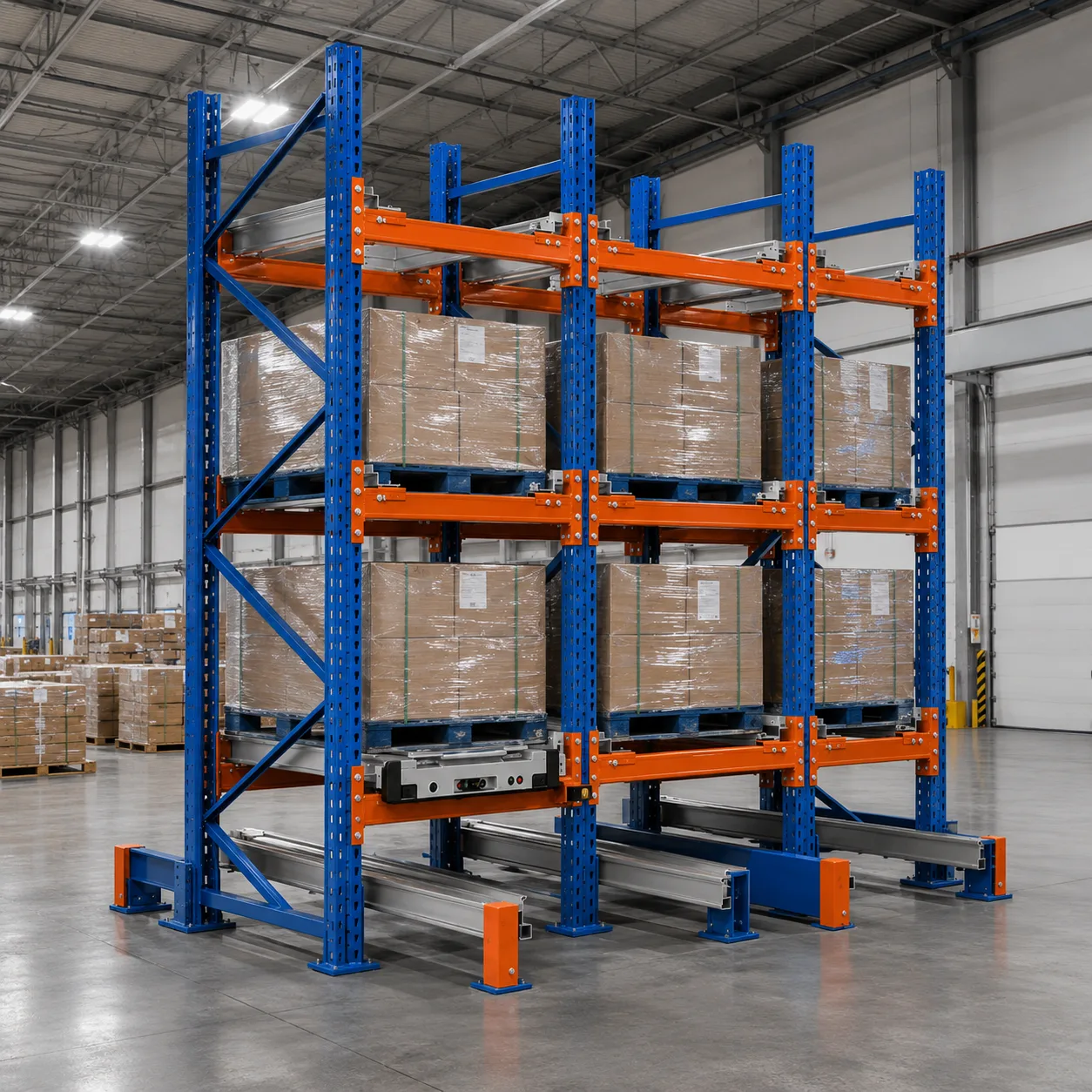
1. High-Bay Rack Structure: Our racks are designed as self-supporting structures or building-integrated (rack-supported) buildings. We utilize multi-fold upright profiles with up to 12 folds, providing exceptional torsional rigidity. This allows our systems to reach heights of 30+ meters while maintaining a safety factor that exceeds international standards.
2. Specialized Guide Rail Systems: We use high-precision, cold-drawn steel rails for both floor and top-guide systems. These rails are laser-aligned during installation to ensure the stacker crane operates with minimal friction and zero vibration, extending the service life of the robotic components.
3. Stacker Crane Integration: The interaction between the rack and the crane is the heart of the system. Our racks feature specialized load-bearing beams with anti-slip surfaces and precision-located positioning holes. This allows the crane’s laser positioning system to calibrate its location at every bay, ensuring perfect pallet placement every time.
Material Science: The Foundation of Durability
The performance of an AS/RS depends entirely on the quality of the steel and the integrity of the manufacturing process. Runda utilizes Q235B or Q345B High-Grade Cold-Rolled Steel as our primary raw material. This steel offers the perfect balance of tensile strength and ductility, essential for supporting the massive static and dynamic loads found in high-bay warehouses.
The Runda 7-Stage Pre-Treatment Process: Before coating, every steel component undergoes a rigorous preparation phase to ensure maximum adhesion and corrosion resistance:
- Alkaline Degreasing (to remove industrial oils)
- Primary Water Rinse
- Acid Pickling (to remove rust and scale)
- Secondary Water Rinse
- Surface Conditioning
- Zinc Phosphating (to create a corrosion-resistant barrier)
- Final Deionized Water Rinse
Electrostatic Epoxy Coating: Following pre-treatment, we apply a high-durability epoxy powder coating. The components are then cured in a 200 degree Celsius oven, resulting in a finish that is resistant to impacts, chemicals, and abrasion. This process ensures that the racking remains maintenance-free for decades, even in high-throughput industrial environments.
Operational Efficiency: Maximizing Throughput and ROI
The primary driver for AS/RS adoption is the dramatic increase in operational efficiency. While traditional warehouses are limited by shift hours and human fatigue, a Runda AS/RS operates 24/7/365 without performance degradation.
1. SKU Density and Picking Speed: By implementing AI-powered path optimization, the system calculates the most efficient route for every retrieval. Frequently accessed items are automatically “shuffled” to the front of the rack during off-peak hours, a process known as slotting optimization. This reduces picking times by up to 40% compared to manual systems.
2. Zero-Error Logistics: Human picking errors are a major hidden cost. Our WCS (Warehouse Control System) verifies every movement via barcode or RFID integration. If the wrong item is detected, the system halts immediately, ensuring that 100% of outbound shipments are correct.
3. Labor Cost Reduction: A single AS/RS operator can manage a system that would typically require 15-20 forklift drivers and pickers. This allows enterprises to reallocate human talent to higher-value roles while significantly reducing the risks associated with warehouse labor turnover.
Safety & Compliance: A Zero-Compromise Approach
Safety is the highest priority in automated environments. Because AS/RS systems involve high speeds and heavy loads, they must adhere to the world’s most stringent engineering codes.
Runda systems are fully compliant with:
- ISO 9001:2015: Global standard for quality management systems.
- CE Certification: Ensuring compliance with European health, safety, and environmental protection standards.
- EN-15512: The European standard for steel static storage systems and adjustable pallet racking.
- RMI (Rack Manufacturers Institute): Compliance with North American safety and design standards.
Our safety features include Emergency Stop Circuits at every access point, Overload Sensors on all lifting mechanisms, and Intrusion Detection Grids that use laser curtains to shut down the system if a human enters the robotic zone.
Installation & Scalability: Future-Proofing Your Business
We recognize that businesses are dynamic. A warehouse design that works today may need to double in capacity five years from now. Runda’s AS/RS is designed with Modular Scalability at its core.
1. Phased Deployment: Clients can start with a 2-aisle system and expand to 10+ aisles as volume grows. The structural design includes pre-drilled connection points for future expansion, and the WMS is designed to integrate new robotics without requiring a full system reboot.
2. Rapid Installation: Our modular components are manufactured with such high precision that on-site welding is virtually eliminated. We use high-tensile bolting systems that accelerate the installation timeline, allowing your facility to go live weeks earlier than competitive systems.
3. Digital Twin Integration: Every system we install comes with a Digital Twin—a 3D virtual model that mirrors the physical warehouse. This allows for risk-free “what-if” testing of new logic or storage strategies before they are deployed in the real world.
Your Partner in Digital Transformation: Runda provides full-lifecycle support, from initial CAD planning and seismic analysis to long-term maintenance and software updates. Contact our engineering team today for a custom automation feasibility study and take the first step toward a zero-error future.
Core Technology Excellence
AI-Powered Logic
Advanced path optimization algorithms dynamically manage stackers and shuttles, reducing idle time and increasing throughput by 40%.
Vertical Density Max
Leverage heights up to 30 meters, transforming your footprint into high-capacity storage that eliminates the need for facility expansion.
Digital Twin Monitoring
Real-time 3D visualization of inventory status and equipment health, enabling predictive maintenance and remote diagnostics.
Modular Scalability
Future-proof design allows for phased deployment—add aisles or robots as your SKU count and order volume grows.
Industry Applications
E-commerce & Fulfillment
Handle massive SKU counts with high-frequency, small-batch picking requirements for rapid delivery.
Pharmaceuticals & Food
Strict batch tracking and First-In-First-Out (FIFO) control ensuring full compliance and safety.
Advanced Manufacturing
Precise line-side material supply and automated part storage for JIT (Just-In-Time) production.
Project FAQ
Q: What is the typical ROI for an AS/RS system?
A: By eliminating picking errors, reducing labor costs by up to 70%, and maximizing storage density, most clients see a full ROI within 18-30 months depending on throughput volume.
Q: Is the system compatible with cold storage?
A: Yes, we provide specialized low-temperature components designed to operate with high precision in environments down to -30 degrees Celsius, using specialized lubricants and thermal-resistant sensors.
Q: What are the maximum height limits for Runda AS/RS installations?
A: Our standard configurations support heights up to 30 meters. For specialized high-bay requirements, we can engineer custom structures exceeding 40 meters, provided the building foundation meets our specified load-bearing tolerances.
Q: How does the system handle earthquake resistance?
A: Every AS/RS is custom-engineered using seismic analysis software. We utilize heavy-duty floor anchoring, reinforced cross-bracing, and specialized rail damping systems to ensure stability in high-seismic zones according to local building codes.
Q: What is the maintenance schedule for the stacker cranes?
A: We recommend a quarterly inspection for mechanical components and a monthly software diagnostic check. The system includes built-in predictive maintenance alerts that monitor motor temperature, vibration levels, and sensor alignment in real-time.
Q: Can the system be integrated with our existing SAP or Oracle ERP?
A: Absolutely. Our Warehouse Control System (WCS) features open API architectures designed specifically for seamless bi-directional data exchange with major ERP platforms like SAP, Oracle, and Microsoft Dynamics.
Q: What happens during a power failure?
A: The system is equipped with fail-safe electromagnetic brakes on all vertical and horizontal axes. In the event of power loss, stackers lock into position instantly to prevent load shifting, while the WMS preserves the exact state of all active tasks.
Q: What is the lead time for a full-scale AS/RS deployment?
A: From initial design approval and CAD finalization, the typical manufacturing and installation window is 16-24 weeks, depending on the complexity and scale of the automation suite.