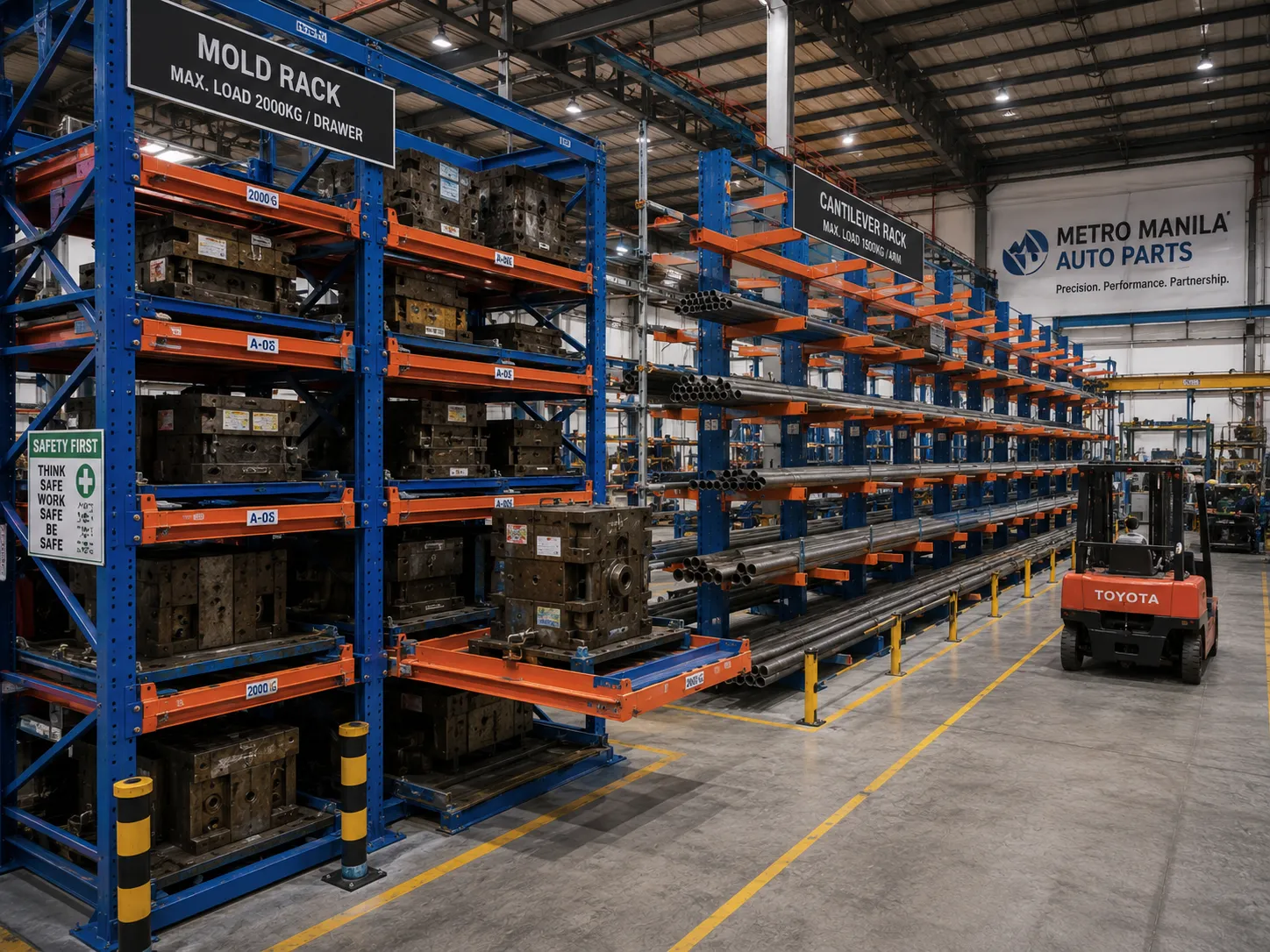
Manila Industrial Manufacturing Plant
Project Overview
The industrial sector in the Philippines is undergoing a significant phase of modernization, particularly within the automotive manufacturing corridor of Metro Manila and Laguna. As global supply chains shift towards regionalized production, local manufacturers are being pressured to increase throughput while adhering to international safety and quality standards. Metro Manila Auto Parts (MMAP), a tier-one supplier for major international vehicle brands, faced a critical operational bottleneck in their primary manufacturing plant. Their storage of heavy-duty industrial molds and long-span raw materials was unorganized, leading to safety risks and production delays. Runda Rack was commissioned to design and install a dual-system storage solution: high-capacity Mold Racks with sliding drawers for precision handling and heavy-duty Cantilever Racking for long-span material management. This project represents a benchmark in industrial storage engineering, achieving a perfect safety record and a 15% reduction in production downtime within an earthquake-prone urban environment.
The Client & Market Context
Metro Manila Auto Parts operates in one of the most demanding manufacturing environments in Southeast Asia. As a supplier of precision engine components and chassis parts, they manage thousands of high-value industrial molds, some weighing as much as 2,000kg. The Philippines’ automotive industry has seen steady growth, driven by the Comprehensive Automotive Resurgence Strategy (CARS) program, which incentivizes local parts production. For MMAP, this growth meant an increase in the variety and volume of production runs, necessitating a more diverse range of molds and raw materials.
The market context in Manila is defined by high real estate costs and the constant threat of seismic activity. Industrial plants cannot simply expand outward; they must optimize their existing footprints. Furthermore, labor safety regulations in the Philippines have become increasingly stringent, with the Department of Labor and Employment (DOLE) conducting rigorous inspections of industrial storage systems. MMAP needed a partner who could provide more than just steel shelving; they needed an engineering firm that understood the nuances of heavy-duty industrial workflows and the technical requirements of seismic-certified structures.
The Challenge (Technical & Operational)
The Manila Industrial Manufacturing Plant project presented several interlocking challenges that required custom engineering solutions.
First, the Weight and Precision of Mold Storage was a primary concern. Industrial molds are not only extremely heavy but also highly sensitive to damage. The client’s previous method involved floor-stacking these molds, which made retrieval difficult and dangerous. To access a mold at the bottom of a stack, multiple other molds had to be moved using overhead cranes, a process that was both time-consuming and prone to causing “micro-damage” to the mold surfaces. A storage solution was required that allowed for individual access to each mold without the need for unstacking.
Second, the Management of Long-Span Materials posed a significant spatial challenge. MMAP utilizes 6-meter long steel pipes and aluminum extrusions as raw materials. Storing these on standard pallet racks was inefficient and created a “snagging” hazard for forklifts. These materials were often left in aisles, obstructing traffic and creating a safety hazard for workers. The solution had to provide a stable, organized environment for these long items while maximizing the use of vertical space.
Third, Seismic Compliance in an Earthquake-Prone Region was non-negotiable. Manila is situated near several active fault lines, and the industrial plant sits on soil that requires careful consideration of structural resonance. Designing a rack that can hold 2,000kg molds and 6-meter pipes at height while remaining stable during a high-magnitude earthquake requires sophisticated structural modeling and specialized anchorage systems.
Finally, the project faced Operational Continuity constraints. The plant operates on a 24/7 production cycle. Any installation of new storage systems had to be phased meticulously to avoid shutting down the production lines. This meant working in tight corridors while heavy machinery and personnel continued to move around the installation site.
Engineering Solution
Runda Rack delivered a dual-system engineering solution designed for maximum load capacity, safety, and seismic resilience.
High-Capacity Sliding Mold Racks: We engineered a series of heavy-duty mold racks featuring a “Sliding Drawer” mechanism. Each drawer is equipped with industrial-grade roller bearings and a precision locking system, capable of supporting up to 2,000kg per level. This design allows operators to pull out a single mold level, providing complete access for the overhead crane. To ensure safety, we integrated a “Single-Drawer Interlock” system, which prevents more than one drawer from being pulled out at a time, maintaining the center of gravity of the rack and preventing tipping.
Heavy-Duty Cantilever Racking System: To address the long-span material storage, we installed a custom-designed Cantilever Racking system. The system utilizes heavy-duty I-beam uprights and adjustable arms that can be configured to accommodate different material lengths and weights. Each arm is fitted with a safety stopper to prevent materials from rolling off, and the uprights are braced with a high-strength X-brace system for lateral stability. The cantilever design eliminates front-facing uprights, allowing for the unobstructed loading and unloading of 6-meter materials using side-loader forklifts.
Seismic Engineering and Anchorage: Both systems were designed using advanced finite element analysis (FEA) to ensure stability during seismic events. We utilized high-tensile Q345B steel for all primary structural members. The racks were secured to the floor using “Hilti Seismic-Rated Expansion Anchors,” which provide superior pull-out resistance during ground movement. We also implemented “Baseplate Leveling” to compensate for the slight irregularities in the industrial floor, ensuring that the heavy loads were perfectly distributed across the structural members.
Integrated Safety Shielding: Given the proximity of the storage areas to pedestrian walkways, we installed heavy-duty safety mesh and “Impact Bollards” at the base of every rack. The bollards protect the structural uprights from accidental forklift collisions, while the safety mesh prevents small tools or debris from falling from the upper levels of the cantilever system.
Business Impact & ROI
The implementation of the Runda Rack systems has transformed the MMAP facility into a world-class manufacturing hub.
Production Efficiency: The 15% reduction in production downtime is directly attributed to the faster retrieval of molds and raw materials. In the past, retrieving a specific mold could take up to 45 minutes of crane time; with the new sliding mold racks, this has been reduced to less than 5 minutes. This efficiency gain translates to several hundred additional production hours per year, significantly increasing the plant’s output.
Safety and Compliance: Since the installation, the facility has maintained a “Zero Incident” record in the storage and handling areas. The elimination of floor-stacking and aisle-obstructing materials has created a safer work environment and ensured 100% compliance with local and international safety audits. This has also led to a reduction in insurance premiums for the facility.
Inventory Integrity: The dedicated storage for molds has virtually eliminated the “micro-damage” caused by stacking and unstacking. This preserves the precision of the molds, leading to higher-quality automotive parts and reducing the costs associated with mold repair and maintenance.
Spatial Optimization: By utilizing vertical space for both molds and long materials, MMAP was able to reclaim approximately 5,000 square feet of floor space. This “recovered” area has been repurposed for a new automated assembly line, allowing the client to expand their production capacity without building a new facility.
Sustainability & Future Proofing
The Runda Rack solution for Metro Manila Auto Parts was built with a long-term view of industrial evolution. The modular nature of the cantilever system allows MMAP to add or adjust arms as their raw material requirements change, ensuring that the system will remain relevant even as automotive designs transition toward new materials like composites or specialized alloys.
The durability of the Q345B steel and the high-quality powder coating ensures that the racks will withstand the humid, tropical environment of Manila without significant corrosion. This reduces the need for frequent replacements, contributing to the facility’s overall sustainability goals. Furthermore, the efficiency gains achieved through the sliding mold racks reduce the energy consumption of the plant’s overhead cranes, lowering the facility’s carbon footprint. By investing in precision-engineered storage, MMAP has not only solved their immediate operational challenges but also created a resilient infrastructure that will support their growth in the competitive ASEAN automotive market for decades to come.
Need a Similar Solution?
Our experts are ready to design a custom display or racking system tailored to your specific goals.