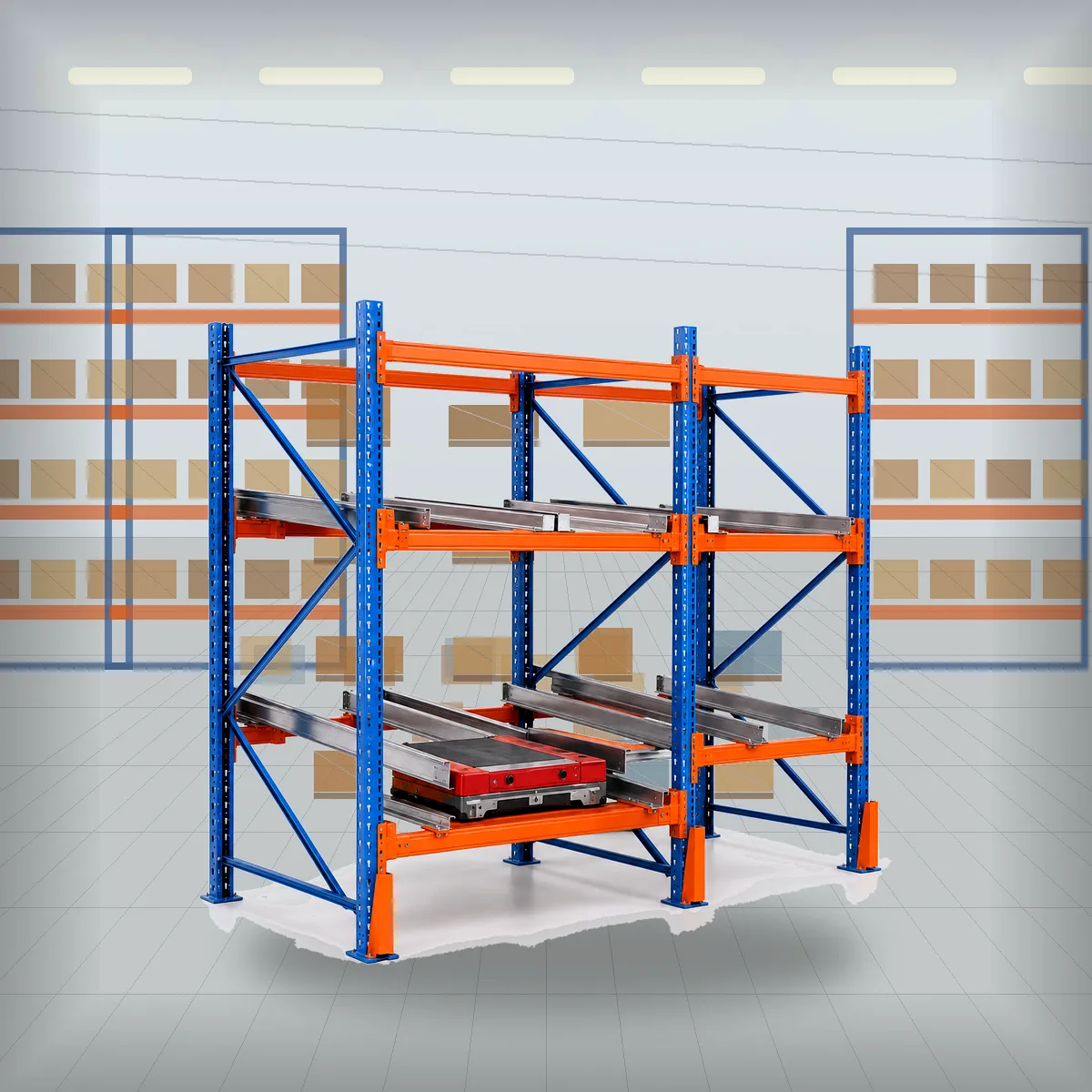
Radio Shuttle Racking System
High-density semi-automated storage solution utilizing robotic shuttles for high-throughput pallet handling, maximizing warehouse volume and operational safety.
Technical Specifications
Global Shipping & Installation Available
Why This Solution?
- Optimized for high-traffic environments
- Premium finishes that enhance product value
- Rapid 24/7 global technical support
Core Technology & Applications
The Definitive Guide to Radio Shuttle Racking Systems
The global logistics landscape is undergoing a fundamental shift toward automation. As land costs rise and labor availability fluctuates, the Radio Shuttle Racking System has emerged as the most practical and cost-effective entry point into automated warehousing. Runda Rack provides a comprehensive semi-automated solution that bridges the gap between traditional manual racking and full-scale ASRS (Automated Storage and Retrieval Systems).
1. Context: The Automation Imperative in Modern Warehousing
In the current industrial climate, efficiency is no longer a luxury—it is a survival requirement. Traditional selective racking, while flexible, wastes up to 60% of warehouse volume on forklift aisles. Conversely, Drive-In racking provides density but suffers from slow operational speeds and high rack-damage rates.
The Radio Shuttle system solves this paradox by utilizing a robotic platform to move pallets within a high-density structure. This allows forklifts to stay in the main travel aisles, significantly reducing travel distances and cycle times. For facilities handling high volumes of low-to-medium SKU counts, the Radio Shuttle system represents the peak of storage ROI.
2. Structural Engineering: The Backbone of High-Density Stability
The Runda Radio Shuttle Rack is not merely a standard rack with a robot; it is a precision-engineered structural system designed to withstand dynamic forces and maintain tight tolerances.
Rail Design and Precision
The core of the system is the specialized shuttle rail. Unlike standard beams, these rails are cold-rolled from high-tensile steel to a specific profile that supports both the pallet and the shuttle wheels. The rail must maintain a horizontal tolerance of less than 2mm over the entire lane length to ensure the shuttle moves without vibration or tracking errors.
Dynamic Load Calculations
Our engineers utilize advanced FEA (Finite Element Analysis) to model the stresses of a moving 1500kg load. We account for the acceleration and braking forces of the shuttle, ensuring the racking uprights and bracing can dissipate these forces without structural fatigue over decades of use.
3. Material Science: Industrial-Grade Durability
At Runda, we believe that the quality of the material dictates the longevity of the system. We use Q235B or Q355B high-grade carbon steel for all structural components, ensuring a high strength-to-weight ratio.
Advanced Surface Treatments
The racking undergoes a multi-stage pretreatment process, including pickling and phosphating, followed by a high-durability electrostatic powder coating. This ensures the steel remains protected against corrosion even in humid or unconditioned warehouse environments.
Robotic Components
The shuttle itself is a marvel of material selection. The chassis is laser-cut from thickened steel plate for rigidity, while the wheels are made from high-density polyurethane to provide maximum grip and minimum wear on the rails. The internal drive system utilizes brushless DC motors, which offer higher efficiency and lower maintenance compared to traditional brushed motors.
4. ROI Analysis: Quantifying the Value
Investing in a Radio Shuttle system is a strategic financial decision. While the initial capital expenditure is higher than selective racking, the long-term savings are substantial.
Labor and Equipment Savings
By reducing forklift travel time, one operator in a shuttle-equipped warehouse can often achieve the throughput of three operators in a selective-rack warehouse. This leads to a direct reduction in payroll and forklift maintenance costs.
Land and Volume Utilization
The Radio Shuttle system can increase storage capacity by up to 100% within the same footprint. In regions with high land costs or expensive refrigerated space, the ability to store more pallets in less space can pay for the entire system within 18 to 24 months.
Reduction in Hidden Costs
Because forklifts do not enter the lanes, the ‘hidden’ costs of rack repairs, pallet damage, and product loss are reduced by nearly 90%. This ensures a more predictable maintenance budget and higher operational uptime.
5. Safety First: Multi-Layered Protection Protocols
Safety is the non-negotiable foundation of all Runda designs. The Radio Shuttle system includes multiple layers of active and passive safety features to protect your staff and inventory.
Active Sensor Suites
Every Runda shuttle is equipped with high-performance laser scanners. These sensors continuously monitor the path for obstacles, including loose packaging, fallen items, or personnel. The shuttle logic includes ‘Slow-Down’ and ‘Emergency-Stop’ zones to ensure smooth and safe deceleration.
Redundancy Systems
In the rare event of a primary sensor failure, the shuttle includes mechanical limit switches and thermal protection for the motors. The battery management system (BMS) constantly monitors cell voltage and temperature, preventing overheating and ensuring long-term battery health.
6. Installation and Commissioning: The Runda Process
A high-performance system requires high-precision installation. Runda’s certified installation teams follow a rigorous protocol to ensure your system performs from day one.
Phase 1: Site Preparation
We begin with a precision laser survey of the warehouse floor. Any deviations in floor level are addressed with high-strength shims to ensure the rails are perfectly horizontal.
Phase 2: Structural Assembly
The racking is assembled using high-tensile bolts and specialized alignment tools. Every lane is verified for width and plumbness before the rails are locked into position.
Phase 3: Shuttle Tuning
Once the racking is complete, our technicians perform ‘live-load’ testing. We run the shuttles through hundreds of cycles with actual pallets to calibrate the sensors, braking distances, and acceleration profiles for your specific pallet types.
Phase 4: Staff Training
The final step is the comprehensive training of your warehouse team. We cover daily operations, battery management, and basic troubleshooting, ensuring your staff feels confident and safe using the new technology.
Conclusion
The Runda Radio Shuttle Racking System is more than a storage solution; it is a catalyst for warehouse transformation. By combining structural integrity with robotic intelligence, we help businesses achieve levels of efficiency that were previously only possible for the world’s largest logistics hubs. Whether you are looking to optimize a cold storage facility or increase the capacity of a manufacturing buffer, the Radio Shuttle system provides the density you need and the performance you demand.
Contact the Runda engineering team today to receive a detailed layout design and ROI calculation for your facility. Let us help you take the first step toward the future of warehousing.
Core Technology Excellence
Robotic Precision Control
Equipped with multiple high-precision laser sensors for real-time pallet detection and obstacle avoidance, ensuring millimeter-accurate positioning in every lane.
High-Density Storage Gain
By eliminating internal access aisles, vertical and depth utilization is increased by over 80% compared to selective systems, doubling your pallet positions.
Dynamic Logic Switching
Easily switch between strict FIFO and maximum-density LIFO modes via remote control to adapt to varying seasonal turnover and inventory requirements.
Industrial-Grade Wireless
Utilizes anti-interference industrial frequencies to ensure zero-latency command transmission even in dense metal environments and complex warehouse layouts.
Industry Applications
Cold Chain Logistics
Minimizes personnel time in sub-zero temperatures while density reduces refrigeration loss and energy costs per pallet position.
FMCG High-Volume Hubs
Supports rapid throughput for high-volume uniform SKUs, perfect for handling food, beverage, and seasonal demand spikes.
Manufacturing Finished Goods
Provides a highly efficient post-production buffer, standardizing the storage and retrieval process for palletized industrial goods.
Project FAQ
Q: What is the primary difference between Radio Shuttle and Drive-In racking?
A: In a Drive-In system, forklifts must physically enter the racking lanes, which increases the risk of structural damage and slows down operation. Radio Shuttle systems keep forklifts at the aisle face, while the robotic shuttle handles in-lane movement. This increases throughput by up to 200% and virtually eliminates rack-collision maintenance costs.
Q: How does the system handle FIFO vs LIFO requirements?
A: The Runda Shuttle system is designed with dual-mode flexibility. For LIFO (Last-In-First-Out), the shuttle operates from a single entry aisle. For FIFO (First-In-First-Out), the shuttle retrieves pallets from the opposite side of the loading aisle. The mode can be toggled via the remote control or integrated WMS software without mechanical changes.
Q: Can the Runda Shuttle operate in cold storage environments?
A: Yes. We offer a specialized Cold Chain Edition designed for temperatures as low as -30 degrees Celsius. These units feature low-temperature resistant lubricants, condensation-proof electronics, and high-performance batteries that maintain efficiency in sub-zero conditions, making them ideal for frozen food logistics.
Q: What safety protocols are integrated into the shuttle hardware?
A: Each shuttle is equipped with dual-laser obstacle detection sensors, mechanical buffers, and emergency stop triggers. If an obstacle or person is detected in the lane, the shuttle stops instantly. It also includes anti-collision sensors for pallet-to-pallet distancing and rail-end sensors to prevent over-travel.
Q: What is the expected lifespan of the lithium battery and the shuttle itself?
A: The LiFePO4 batteries are rated for over 2000 charge cycles, typically lasting 5 to 7 years depending on shift intensity. The shuttle chassis, built from high-strength steel and industrial-grade components, has a design life of 10 to 15 years with regular preventive maintenance.
Q: What happens if a shuttle malfunctions deep inside a lane?
A: Runda shuttles include an emergency recovery mode. A secondary 'rescue shuttle' or a specialized recovery tool can be used to retrieve the stalled unit. Additionally, the remote control provides diagnostic error codes to help operators quickly identify and resolve minor sensor or battery issues on-site.
Q: Is the system compatible with existing Warehouse Management Systems (WMS)?
A: Absolutely. While the standard system operates via remote control, we offer an API-enabled version that integrates directly with your WMS. This allows for automated task queuing, real-time inventory tracking, and fleet management of multiple shuttles across different levels.
Q: What are the floor requirements for installing a Shuttle Rack system?
A: Due to the high-density nature and concentrated loads, the warehouse floor must be level (typically Class FM2 or better) and have sufficient load-bearing capacity (usually 5-8 tons per square meter). We perform a comprehensive floor survey during the design phase to ensure long-term structural stability.