Drive-In Pallet Racking
High-density pallet storage solution designed to maximize volumetric space by eliminating aisles. Ideal for cold storage and bulk inventory.
Technical Specifications
Global Shipping & Installation Available
Why This Solution?
- Optimized for high-traffic environments
- Premium finishes that enhance product value
- Rapid 24/7 global technical support
Core Technology & Applications
Technical Guide to Drive-In Pallet Racking Systems
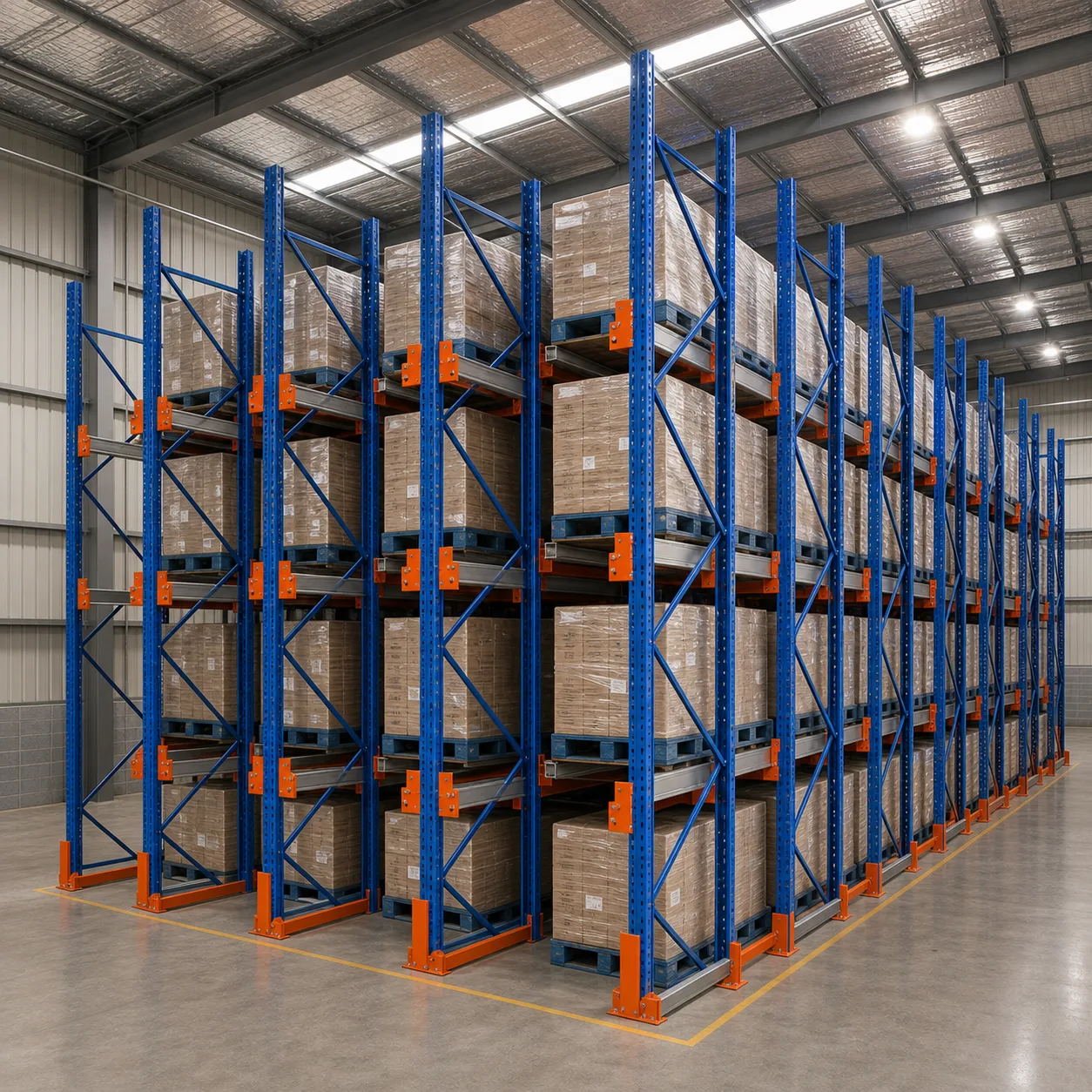
The Runda Drive-In Racking system is the definitive solution for high-density bulk storage of uniform products. By eliminating multiple access aisles, it transforms your warehouse into a high-capacity logistics engine, offering the lowest cost-per-pallet position among all high-density storage methods. Designed for industries with low SKU counts and high pallet volumes, Drive-In racking maximizes volumetric space utilization, making it an essential asset for cold storage facilities, beverage distributors, and raw material warehouses.
Industry Context: The Battle for Volumetric Efficiency
In the modern supply chain, warehouse space is no longer just measured in square meters; it is measured in cubic volume. As industrial real estate costs continue to soar, the ability to store more pallets in the same building footprint is a critical competitive advantage. Traditional selective racking, while offering 100% accessibility, typically only utilizes about 40% of a warehouse’s total volume due to the need for wide forklift aisles.
Runda’s Drive-In systems solve this by utilizing a “block storage” philosophy. By allowing forklifts to drive directly into the racking lanes, we eliminate up to 75% of the aisle space required by standard systems. This is particularly critical in Cold Storage and Freezer environments, where the cost of cooling empty air is a significant operational drain. By packing inventory more densely, Drive-In racking improves thermal inertia and reduces refrigeration energy consumption by up to 30%.
Structural Engineering: Stability Without Horizontal Beams
The engineering of a Drive-In rack is fundamentally different from standard pallet racking. Because there are no horizontal beams in the lanes where the forklift operates, the system must derive its structural integrity from alternative sources.
1. The Cantilever Rail System: Instead of beams, pallets rest on continuous side-rails supported by cantilever arms. Runda’s rails are cold-rolled from high-gauge steel with a specialized “lipped” profile. This profile provides maximum vertical load-bearing capacity while offering a wide surface area for the pallet edges, reducing the risk of pallet slippage.
2. Upright Design and Tapered Geometry: Our uprights feature a high-performance multi-fold design. To assist forklift entry, the base of the uprights is often tapered or fitted with specialized “lead-in” guides. This protects the structure from the frequent “side-swiping” impacts that are common in deep-lane storage systems.
3. Advanced Bracing Architecture: To compensate for the lack of front-to-back beams, Runda utilizes a robust system of Top Bracing and Back Bracing. These structural members connect the tops of the uprights across the aisles, creating a rigid “box” that resists the longitudinal forces generated when a forklift accelerates or brakes within the lane.
Material Science: Engineering for Impact and Extremes
Drive-In racks are subjected to more physical interaction with forklifts than almost any other racking type. Therefore, material selection and coating durability are paramount.
Q235B High-Grade Structural Steel: We utilize Q235B steel for its excellent balance of tensile strength and ductility. In a Drive-In system, the steel must be able to absorb minor impacts without cracking. Our components are manufactured with tight tolerances to ensure that load distribution remains uniform across all connection points.
Protective Coatings for Cold Chain Logistics: Many Drive-In systems are installed in sub-zero temperatures. Runda utilizes a specialized electrostatic powder coating that remains flexible and impact-resistant even at -40 degrees Celsius. For high-corrosion environments or wet-storage areas, we offer Hot-Dip Galvanized finishes that provide lifetime protection against oxidation and chemical cleaners.
Operational Efficiency: Reducing Travel and Maximizing Density
Efficiency in a Drive-In system is measured by the number of pallets moved per hour and the total storage density achieved.
1. Reduced Forklift Travel Distance: In a selective racking system, a forklift must travel down long aisles to reach specific positions. In a Drive-In system, large volumes of the same SKU are concentrated in single lanes. During “batch retrieval,” the forklift moves back and forth in a single, short lane, significantly reducing cycle times and battery consumption.
2. Block Storage ROI: By doubling the storage capacity within the same footprint, Drive-In racking effectively halves the real estate cost per pallet. For facilities that store seasonal inventory or high-volume consumer goods, this ROI is realized within the first 12-18 months of operation.
3. LIFO vs. Drive-Through FIFO: Our systems can be configured as “Drive-In” (Single Entry) for LIFO logic or “Drive-Through” (Double Entry) for FIFO logic. This flexibility allows us to tailor the system to your specific inventory turnover requirements, ensuring that your picking logic is never compromised for the sake of density.
Safety & Compliance: A Multi-Layered Protection Strategy
Because forklifts operate inside the structure, safety is the primary engineering concern. Runda’s safety suite is designed to prevent accidents before they happen.
1. Floor-Mounted Guide Rails: We recommend high-visibility steel guide rails bolted to the floor. These rails physically center the forklift within the lane, preventing the mast or the load from striking the uprights. This is the single most effective way to reduce maintenance costs in a Drive-In environment.
2. Pallet Entry Guides and Stops: Each rail features a tapered “entry-guide” to help the operator align the pallet. At the rear of the lane, heavy-duty mechanical stops ensure the pallet cannot be pushed through the back of the rack, preventing damage to the building walls or the bracing.
3. Structural Compliance: Runda Drive-In systems are designed in accordance with:
- EN-15512: Structural design of adjustable pallet racking.
- RMI (Rack Manufacturers Institute): Specifications for industrial steel storage racks.
- ISO 9001: Quality-assured manufacturing processes.
Installation & Scalability: Modular and Future-Proof
Runda’s modular design philosophy ensures that your storage system can evolve with your business needs.
1. Customizable Depth and Height: Every facility has different ceiling heights and floor load capacities. Our engineers provide custom calculations for every project, optimizing the number of levels and the depth of the lanes to ensure you are utilizing every cubic centimeter of available space.
2. Rapid On-Site Assembly: Our components are manufactured with precision-punched holes and high-tensile bolted connections. This allows for rapid assembly without the need for on-site welding, reducing installation timelines and minimizing warehouse downtime.
3. Integration with Other Systems: It is common for facilities to use Drive-In racking for their high-volume SKUs while using selective racking for low-volume items. Runda’s components are designed to be compatible across our entire product line, allowing for a seamless, integrated warehouse solution.
Master Your Volumetric Space: Runda provides more than just steel; we provide a high-density strategy. Contact our engineering team today for a custom storage density analysis and take the first step toward a more efficient, high-capacity future.
Core Technology Excellence
Maximum Volume Efficiency
Eliminates multiple access aisles to double your storage capacity within the same square footage compared to selective racking.
Reinforced Support Rails
Custom-profiled load rails provide extreme shear strength and rigidity, ensuring long-term structural integrity under heavy loads.
Floor Guidance System
Integrated physical rails assist forklift positioning, reducing cycle times and protecting the rack structure from accidental impact.
Cold Chain Optimized
Ultra-dense storage reduces refrigeration loss and energy costs, with specialized finishes for environments down to -40°C.
Industry Applications
Industrial Cold Storage
Maximizes expensive refrigerated space and ensures thermal consistency by reducing empty aisle volume.
Beverage & FMCG Bulk
Perfect for high-volume storage of uniform SKUs, supporting large-scale seasonal stock management.
Raw Material Buffering
Provides ultra-dense storage near production lines to ensure a continuous supply of manufacturing inputs.
Project FAQ
Q: How does Drive-In racking differ from standard selective pallet racking?
A: Selective racking requires an aisle between every double row of racks, whereas Drive-In racking allows the forklift to drive directly into the racking lane to deposit or retrieve pallets. This eliminates the need for multiple access aisles, increasing storage density by up to 75% for the same warehouse footprint.
Q: Is Drive-In racking safe for standard forklift operators?
A: Yes. Runda incorporates several safety features to assist operators, including floor-mounted guide rails that center the forklift within the lane, tapered entry-uprights for easier alignment, and high-visibility pallet stops at the end of each rail to prevent over-insertion.
Q: What are the inventory logic limitations of a Drive-In system?
A: Drive-In systems primarily follow Last-In-First-Out (LIFO) logic. The first pallet placed in a lane is the last one to be removed. This makes it ideal for bulk storage of uniform SKUs with long shelf lives or items that are shipped in large batches.
Q: Can this system be converted to First-In-First-Out (FIFO)?
A: By configuring the system as 'Drive-Through' (accessible from both the front and rear faces), you can achieve FIFO logic. This is common in facilities where loading happens on one side of the rack and picking happens on the other.
Q: How does the system maintain structural stability without traditional cross-beams?
A: Since Drive-In racks lack horizontal beams in the driving lanes, we utilize heavy-duty top-bracing and back-bracing (in single-entry systems) to create a rigid 'cube' structure. The upright profiles are also reinforced with specialized multi-fold geometry to resist torsional forces.
Q: Are specialized pallets required for Drive-In systems?
A: Standard Euro or GMA pallets can be used, but they must be in good condition. Because the pallet is supported only by the edges (resting on side rails), any structural weakness in the pallet's bottom boards could lead to failure. We recommend using high-quality wooden or plastic pallets.
Q: What is the maximum depth and height for a Runda Drive-In installation?
A: Standard configurations typically go up to 10 pallets deep and 12 meters high. However, our engineers can customize deeper lanes provided the forklift mast and floor tolerances meet the requirements for safe high-altitude maneuvering.
Q: How does Drive-In racking perform in cold storage environments?
A: It is the industry standard for cold storage. By maximizing storage density, it reduces the 'empty air' volume that needs to be refrigerated, leading to energy savings of up to 30%. Our steel and coatings are specifically rated for environments as low as -40 degrees Celsius.