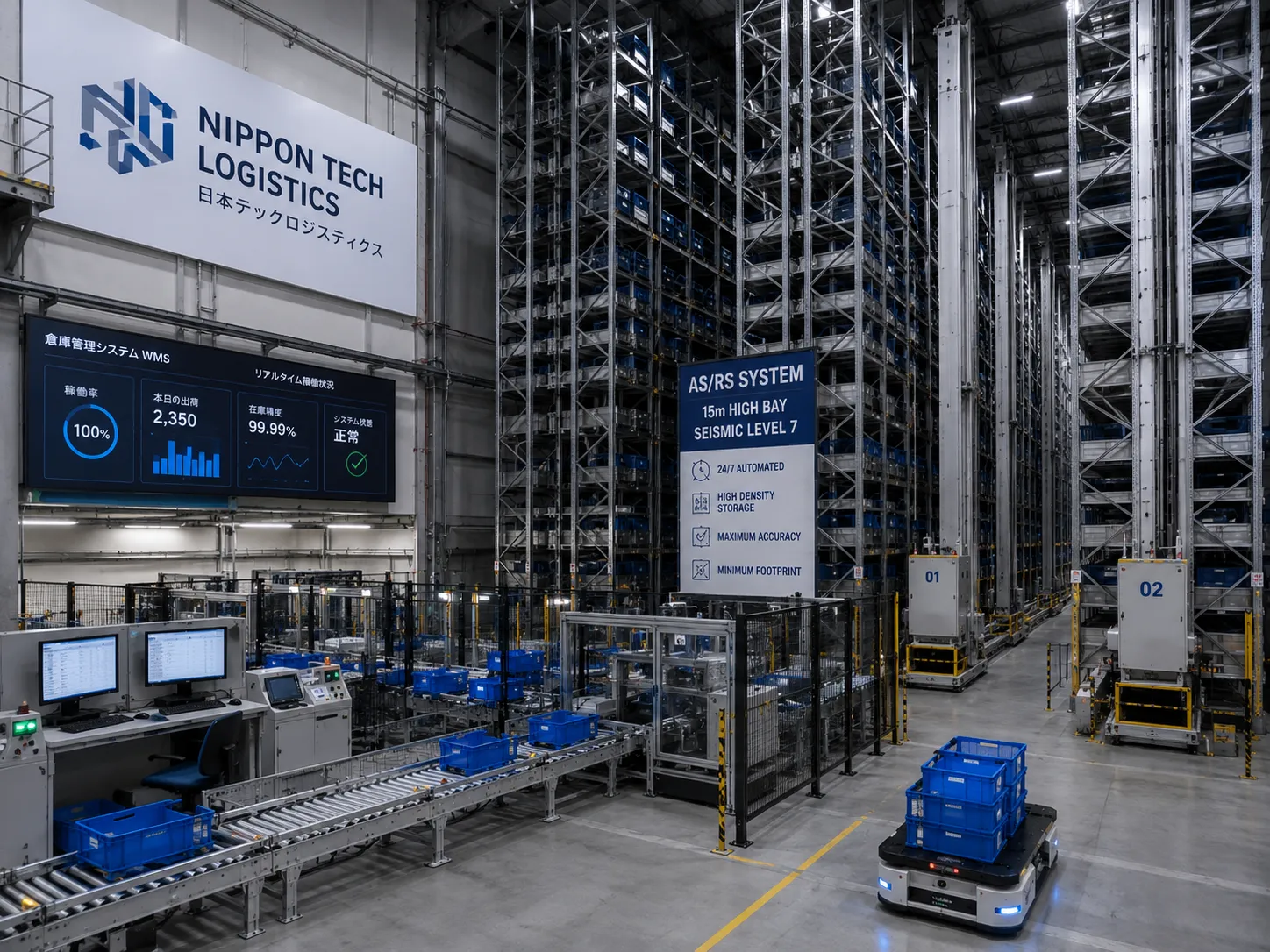
Tokyo Automated Logistics Center
Project Overview
Japan’s logistics sector is currently undergoing a “Digital Transformation” (DX) driven by a critical labor shortage and the extreme scarcity of industrial land in urban centers like Tokyo. For Nippon Tech Logistics (NTL), a leading distributor of high-value electronic components, the traditional warehouse model had become an impediment to their growth. They required a state-of-the-art facility capable of 24/7 autonomous operation, with zero human intervention in the primary storage zones. Runda Rack was commissioned to design and engineer a 15-meter tall Automated Storage and Retrieval System (AS/RS) that integrated precision steel structures with advanced robotic interfaces. This project represents a benchmark in “Hyper-Density Automation,” achieving a 90% reduction in manual labor and a 3x increase in inventory volume, all within a Grade-7 seismic-rated framework.
The Client & Market Context
Nippon Tech Logistics operates at the heart of the global electronics supply chain, managing hundreds of thousands of individual SKUs for the automotive, aerospace, and consumer electronics sectors. In the Japanese market, where “Omotenashi” (exceptional service) and “Kaizen” (continuous improvement) are cultural imperatives, the standard for logistics is perfection. Shipping errors are not just a cost; they are a significant reputational risk.
The Tokyo market presents the ultimate challenge for logistics engineering. Industrial land prices are among the highest in the world, and the labor market is one of the tightest, with an aging population leading to a “Logistics 2024” crisis—a projected shortage of warehouse and transport workers. To survive, companies must automate. However, Japan is also the world’s most seismically active region. Any tall automated structure must be capable of withstanding massive earthquakes while maintaining the sub-millimeter tolerances required for high-speed robotic cranes to function. NTL needed a partner who could deliver a system that was both technologically advanced and structurally invincible.
The Challenge (Technical & Operational)
The Tokyo Automated Logistics Center project involved several interlocking high-stakes challenges that required a specialized, multidisciplinary engineering approach.
First, “Sub-Millimeter Vertical Tolerance at 15 Meters” was the primary structural hurdle. Automated cranes (Stacker Cranes) travel at high speeds (up to 200 meters per minute) and must position themselves with absolute precision to pick or place a pallet. If a 15-meter tall rack has even a 2-millimeter “Lean” or “Sway,” the crane’s sensor system will trigger a safety shutdown, halting the entire facility. Achieving this level of precision in a steel structure of this scale requires advanced manufacturing techniques and a specialized installation protocol.
Second, “Grade-7 Seismic Stability and Resilience” was a non-negotiable safety requirement. The Tokyo Metropolitan Government has some of the world’s strictest building codes. The racking system had to be designed to not only withstand a major earthquake without collapsing but to remain “Operational” immediately after the event. This means the structure must absorb and dissipate seismic energy without any permanent deformation of the crane rails or the racking members.
Third, “Seamless Robotic and WMS Integration” was an operational mandate. The physical racking structure had to serve as the “Skeleton” for a complex network of sensors, laser guides, and high-speed busbars. Every beam and upright had to be manufactured with integrated mounting points that aligned perfectly with the robotic components. Any deviation during the manufacturing process would lead to significant delays during the site integration phase.
Finally, “Maximum Density vs. 24/7 Availability” was a spatial paradox. NTL required the system to operate 24/7, which means there is no “Maintenance Window” during the day. The layout had to be engineered for high redundancy—if one crane requires maintenance, the rest of the system must continue to operate at near-peak capacity. The density requirements were so extreme that there was zero room for traditional maintenance access corridors within the racking block itself.
Engineering Solution
Runda Rack delivered a high-performance AS/RS solution that utilized advanced material science and high-precision manufacturing.
Nine-fold High-Tensile Structural Steel: We utilized our proprietary Nine-fold Upright system, manufactured from Q345B high-tensile steel. The nine-fold design provides superior torsional rigidity compared to standard C-profiles, which is essential for maintaining verticality under the extreme dynamic loads of high-speed cranes. Every component was manufactured using CNC laser-cutting and automated welding to ensure a tolerance of +/- 0.5mm across the entire 15-meter height.
Seismic Energy Dissipation and High-Ductility Anchorage: To meet the Grade-7 seismic requirement, we engineered a “Base-Isolated” anchorage system. This utilized specialized “Seismic Dampening Baseplates” that allow for a controlled degree of horizontal movement during an earthquake, dissipating energy before it reaches the main structure. We used “High-Ductility Steel Alloys” for the bracing systems, which can undergo significant elastic deformation without failing, effectively acting as a shock absorber for the warehouse.
Integrated Sensor and Rail Mounting System: We designed the racking uprights with “Pre-Engineered Mounting Channels” for the crane rails and the WMS sensor network. These channels were integrated during the cold-rolling process, ensuring perfect alignment across the entire length of the aisles. This “Plug-and-Play” approach reduced the on-site robotic integration time by 40% and ensured that the laser-guided cranes achieved a “First-Pass Success” rate of 100% during the commissioning phase.
High-Density “Double-Deep” Configuration: To achieve the 3x inventory volume, we implemented a “Double-Deep” AS/RS configuration. This utilizes specialized cranes with telescopic forks that can reach two pallet positions deep from a single aisle. This design significantly reduces the number of aisles required, maximizing the usable “Air Space” within the facility. The structure was engineered to support the increased cantilever loads generated by the telescopic fork operation.
Business Impact & ROI
The implementation of the AS/RS system has transformed Nippon Tech Logistics into the most efficient electronics hub in Tokyo.
Labor and Operational Savings: The 90% reduction in manual labor has allowed NTL to reassign over 50 warehouse workers to higher-value roles in quality control and customer service. The facility now operates with a “Lights-Out” protocol during the night shift, reducing energy costs and eliminating the need for premium night-shift labor rates.
Throughput and Accuracy Excellence: Order accuracy reached an unprecedented 99.99%. In the high-value electronics sector, this has saved the client an estimated $2.5 million annually in lost inventory and shipping corrections. Order cycle times were reduced by 60%, allowing NTL to offer an “Express Dispatch” service that has attracted three new multinational corporate clients.
Asset and Real Estate ROI: The 3x increase in inventory volume allowed NTL to cancel a planned $15 million expansion project for a second facility. By maximizing their current site, they have significantly improved their balance sheet and achieved a full ROI on the automation investment within 30 months.
Brand Reputation and Compliance: The Grade-7 seismic rating has become a major selling point for NTL when bidding for aerospace and defense contracts. Clients are willing to pay a premium to store their critical components in a facility that is guaranteed to survive and remain operational during Japan’s periodic seismic events.
Sustainability & Future Proofing
Sustainability was integrated through “Energy Recovery” and “Material Efficiency.” The AS/RS stacker cranes are equipped with “Regenerative Braking” systems that feed electricity back into the warehouse grid during the descent of heavy pallets. The high-density design reduces the “Thermal Envelope” per pallet, lowering the energy required for lighting and climate control by 40% compared to a traditional warehouse.
The Runda Rack structure is designed for “30-Year Longevity.” By utilizing high-grade steel and a specialized anti-corrosion coating, we have ensured that the core infrastructure will outlast multiple generations of robotic technology. The modular design of the crane rails and sensor channels allows NTL to upgrade their robotic fleet in the future without modifying the primary steel structure.
Furthermore, the system is “Fully Digitalized.” Every pallet position is tracked in real-time within the WMS, providing NTL with “Total Inventory Transparency.” This data is used to optimize picking routes and predict seasonal demand surges, ensuring that the Tokyo Automated Logistics Center remains at the absolute cutting edge of the global logistics industry for decades to come.
Need a Similar Solution?
Our experts are ready to design a custom display or racking system tailored to your specific goals.