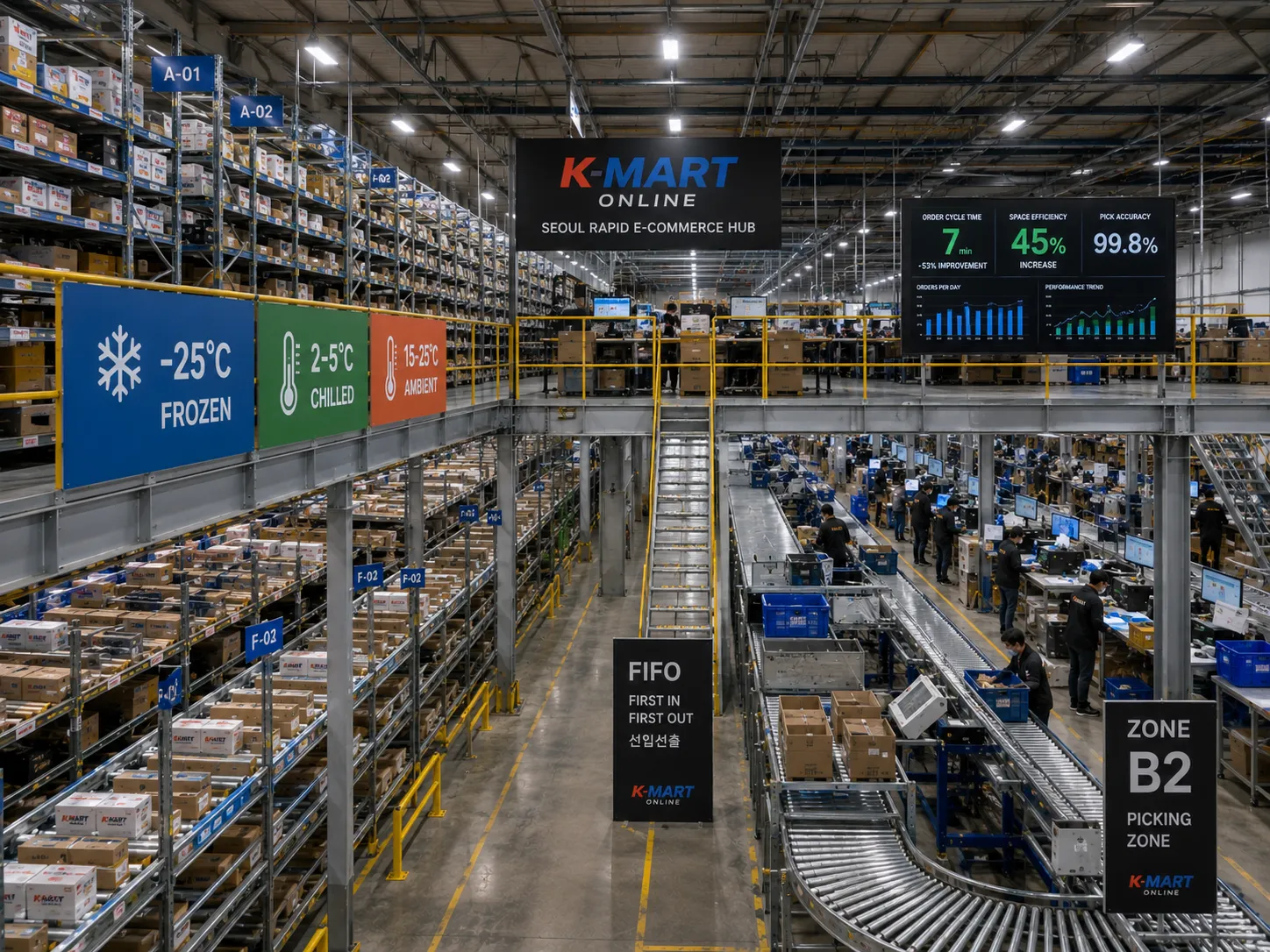
Seoul Rapid E-commerce Hub
Project Overview
The e-commerce market in South Korea is one of the most advanced and demanding in the world, characterized by high consumer expectations for “Dawn Delivery” and “1-Hour Fulfillment.” For K-Mart Online, a leading grocery provider in the Seoul metropolitan area, staying competitive meant radically optimizing their primary fulfillment hub. The challenge was to manage a complex mix of dry goods, chilled products, and frozen inventory within a high-density urban facility where real estate costs are among the highest in Asia. Runda Rack was commissioned to design and implement a Gravity Flow and Structural Mezzanine Hybrid system, specifically engineered for high-velocity picking and strict First-In, First-Out (FIFO) management. This project represents a milestone in “Hyper-Local Fulfillment” engineering, delivering a 53% reduction in order cycle times and a 45% increase in space efficiency within a record-breaking 4-week deployment window.
The Client & Market Context
K-Mart Online is at the forefront of the Korean “Quick-Commerce” revolution. In a city like Seoul, where over 10 million people live in high-density high-rises, the logistics of food delivery are incredibly complex. Consumers expect their groceries to be delivered within hours of ordering, and the margin for error in picking accuracy or product freshness is near zero. The South Korean market is also highly regulated in terms of food safety, with the Ministry of Food and Drug Safety (MFDS) setting rigorous standards for “Cold-Chain Integrity” and facility hygiene.
The market context in Seoul is defined by “Vertical Logistics.” Because horizontal expansion is impossible in the city center, fulfillment centers must utilize every cubic meter of vertical space. Furthermore, the labor market in Korea is shifting toward increased automation and ergonomic workstations to improve worker retention and productivity. K-Mart Online needed a storage partner that could provide a sophisticated, multi-level infrastructure capable of supporting high-speed manual picking today while being “Automation-Ready” for the future.
The Challenge (Technical & Operational)
The Seoul Rapid E-commerce Hub project presented a set of interlocking technical challenges that required a departure from traditional warehouse design.
First, “Mandatory FIFO at High Velocity” was the primary operational requirement. In the grocery sector, managing expiry dates is critical. Perishable items like dairy, fresh produce, and meats must be picked in the exact order they were received. In a traditional static racking system, this requires workers to reach behind older stock, which is slow and prone to errors. K-Mart needed a system where the stock “automatically” rotated, ensuring that the oldest items were always at the front of the picking face.
Second, “Extreme Picking Congestion and Throughput” posed a significant spatial challenge. The hub processes thousands of orders per hour, with hundreds of picking staff moving through the aisles simultaneously. Traditional aisle layouts would lead to “Traffic Jams,” where pickers are stuck behind colleagues or restocking carts. The layout had to be engineered for “Uni-Directional Flow,” separating the restocking activities from the picking activities to eliminate bottlenecks and ensure a smooth, continuous operation.
Third, “Cold-Chain and Sub-Zero Structural Engineering” was a critical technical constraint. A significant portion of the hub is dedicated to refrigerated and frozen goods, with temperatures reaching as low as -25 degrees Celsius. Standard steel becomes brittle at these temperatures, and traditional powder coatings can crack and peel. The racking had to be constructed from specialized “Low-Temperature Grade Steel” and finished with a coating that could withstand thermal expansion and contraction without compromising hygiene.
Finally, the “Hyper-Accelerated Project Timeline” was a major logistical hurdle. K-Mart Online needed the system to be fully operational before the Chuseok (Korean Thanksgiving) peak season. This meant that the entire multi-level mezzanine and gravity flow system had to be designed, manufactured in our precision facility, shipped to Seoul, and installed on-site within just 28 days.
Engineering Solution
Runda Rack delivered a hybrid engineering solution that integrated three-dimensional space utilization with gravity-driven material handling.
High-Density Gravity Flow Systems: We installed custom-engineered “Carton Flow” racks for high-frequency SKUs. These racks utilize slightly inclined lanes with precision-grade rollers. When a picker removes an item from the front face, the next item automatically slides forward, ensuring perfect FIFO rotation. We utilized “Full-Width Roller Tracks” to provide maximum flexibility for different carton sizes, and integrated “Impact-Resistant End-Stops” to prevent product damage at the picking face.
Heavy-Duty Structural Mezzanine Integration: To maximize the 12-meter ceiling height, we engineered a 5,000 square meter structural mezzanine above the primary cold storage zone. This mezzanine was designed with a “Long-Span Beam System,” reducing the number of support columns on the ground floor to allow for the unobstructed movement of pallet jacks and conveyor systems. The mezzanine level serves as a dedicated packing and sorting hub, effectively doubling the usable floor area of the facility.
Low-Temperature Engineering and Antimicrobial Finishes: For the cold storage zones, we utilized high-tensile steel with a specific chemical composition designed for “Cryogenic Resilience.” All components were treated with an “Antimicrobial Polyester Coating” that inhibits the growth of bacteria and mold—a critical requirement for MFDS compliance. The coating was applied using a specialized “Thermal-Bond” process that ensures it remains flexible and intact even during rapid temperature fluctuations.
Ergonomic Picking Zones and Uni-Directional Layout: We designed the layout using a “Pick-to-Light Compatible” architecture. The gravity flow racks were positioned in “Zoned Picking Cells,” and the aisles were wide enough to allow for “Overtaking Lanes.” We separated the “Loading Face” (at the back of the rack) from the “Picking Face” (at the front), ensuring that restocking personnel never interfere with the pickers, effectively eliminating congestion during peak periods.
Business Impact & ROI
The implementation of the Runda Rack hybrid system has transformed K-Mart Online’s fulfillment capabilities, allowing them to dominate the Seoul grocery market.
Order Cycle Reduction: The 53% reduction in order cycle time—from 15 minutes down to just 7 minutes—is the most significant achievement of the project. This speed allows K-Mart to comfortably fulfill their 1-hour delivery guarantee, even during peak afternoon and evening surges. This competitive advantage has led to a 20% increase in their market share in the Gangnam and Seocho districts.
Throughput and Capacity: The 45% increase in space efficiency enabled the hub to process three times its previous daily order volume without increasing its footprint. The mezzanine integration allowed for the consolidation of three smaller satellite warehouses into this single “Super-Hub,” reducing facility overheads by $1.2 million annually.
Picking Accuracy and Quality: The automated FIFO rotation and the organized picking faces have resulted in a 99.8% picking accuracy rate. This has significantly reduced the costs associated with “Reverse Logistics” (returns) and has improved customer satisfaction scores, as consumers consistently receive the freshest possible products.
Safety and Employee Retention: The ergonomic design of the picking zones and the mezzanine floor (which utilizes “High-Grip Perforated Steel Decking”) has led to a 40% reduction in workplace strain and minor injuries. This has improved worker morale and reduced employee turnover in a highly competitive labor market.
Sustainability & Future Proofing
Sustainability was integrated through “Thermal Efficiency” and “Material Longevity.” The mezzanine design was engineered to allow for “Natural Convection,” reducing the energy required to maintain the temperature in the cold storage zones below. By consolidating their operations into a single high-efficiency hub, K-Mart has also reduced the carbon footprint associated with inter-warehouse transportation.
The Runda Rack system is designed for “Modular Scalability.” As K-Mart transitions toward further automation, the gravity flow racks can be easily integrated with “Autonomous Mobile Robots” (AMRs) or “Automated Storage and Retrieval Systems” (ASRS). The structural mezzanine was engineered with “Excess Load Capacity” to support the future installation of heavy high-speed sorting machinery.
Furthermore, the “C-Profile” steel design used throughout the facility is 100% recyclable. At the end of the system’s lifecycle—estimated to be 20+ years—the materials can be repurposed, aligning with South Korea’s national “Green Logistics” initiatives. By investing in this high-performance infrastructure, K-Mart Online has not only solved their immediate fulfillment challenges but also secured a technologically resilient foundation for the next generation of e-commerce.
Need a Similar Solution?
Our experts are ready to design a custom display or racking system tailored to your specific goals.