Mumbai Petrochemical Storage
Project Overview
The petrochemical and chemical logistics sector in India is a critical backbone of the national economy, with Mumbai serving as a primary maritime gateway and distribution hub. For Bharat Petro-Logistics, managing a high-throughput chemical distribution facility in the coastal environment of Mumbai presented a unique set of engineering and operational hurdles. The combination of high ambient humidity, salt-laden air, and the storage of hazardous liquid chemicals required a storage solution that went far beyond standard industrial racking. Runda Rack was commissioned to design, engineer, and install a specialized Galvanized Heavy-Duty Pallet Racking system, integrated with advanced spill containment and anti-static features. This project showcases the intersection of material science and structural engineering, delivering a system with a projected 10+ year lifespan in one of the most corrosive industrial environments in the world while increasing storage density by 30%.
The Client & Market Context
Bharat Petro-Logistics (BPL) is a leading provider of specialized warehousing and distribution services for the Indian petrochemical industry. Their facility in Navi Mumbai is a strategic node for the movement of chemical drums and intermediate bulk containers (IBCs) destined for pharmaceutical, automotive, and industrial manufacturers across Western India. The Indian chemical market is one of the fastest-growing in Asia, driven by the government’s Make in India initiative and the expansion of the domestic manufacturing base.
In the Mumbai market, industrial space is at a premium, and the environmental conditions are notoriously harsh. The coastal humidity often exceeds 80%, which, when combined with industrial pollutants and sea salt, creates an atmosphere that can oxidize standard steel structures in a matter of months. Furthermore, the storage of hazardous chemicals is governed by strict regulations from the Petroleum and Explosives Safety Organization (PESO) and the Maharashtra Pollution Control Board (MPCB). BPL needed a storage partner capable of delivering a solution that satisfied both the extreme environmental demands and the complex regulatory requirements of chemical logistics.
The Challenge (Technical & Operational)
The Mumbai Petrochemical Storage project involved a series of high-stakes technical challenges that required a customized, multi-layered engineering approach.
First, the Extreme Coastal Corrosion was the most immediate threat. Traditional powder-coated racking, while durable in inland environments, is susceptible to “under-film corrosion” in high-humidity coastal areas. Once a small scratch occurs in the coating, the salt-laden moisture quickly infiltrates the steel, leading to structural weakening that is often invisible until a failure occurs. BPL required a system where the corrosion protection was an integral part of the steel itself, not just a surface treatment.
Second, the Weight and Stability Requirements for liquid storage were significant. A standard 200-liter chemical drum weighs approximately 220kg, and when stored four to a pallet, the weight can exceed 900kg per pallet position. IBCs can weigh even more. These loads are “dynamic” in nature, as the liquid contents can shift during loading or unloading, creating lateral forces on the racking system. The racks had to be engineered for high static loads while maintaining extreme rigidity against dynamic shifts.
Third, Hazardous Material Safety and Spill Management were critical operational priorities. In a chemical warehouse, a single leaking drum can lead to a catastrophic environmental incident or a fire hazard. The racking system had to integrate spill containment at the source, preventing any leaks from reaching the floor or contaminating other inventory on lower levels. Furthermore, the storage of flammable chemicals required the elimination of static electricity buildup within the steel structures.
Finally, the Mumbai Seismic Zone classification added another layer of complexity. Mumbai is located in Seismic Zone III, requiring structures to withstand significant horizontal accelerations. Designing a rack that is both heavy-duty and corrosion-resistant while maintaining seismic stability for high-density chemical storage requires precision structural modeling.
Engineering Solution
Runda Rack delivered a high-performance engineering solution that utilized advanced material treatments and specialized safety integrations.
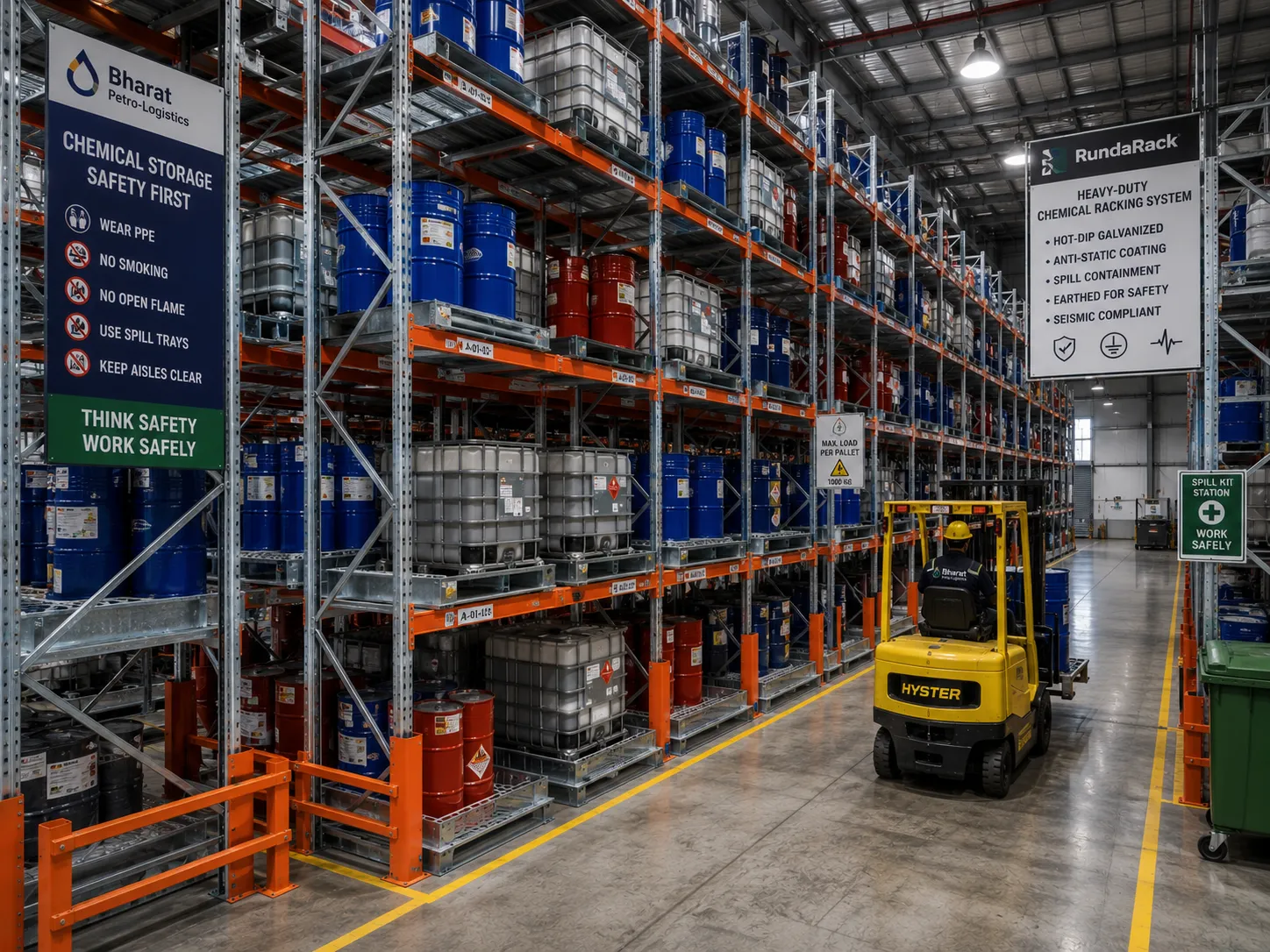
Dual-Layer Corrosion Protection: We utilized a “Hot-Dip Galvanized” (HDG) process for all structural components, including uprights, beams, and bracing. In the HDG process, the steel is submerged in molten zinc, creating a metallurgical bond that provides a sacrificial layer of protection even if the surface is scratched. To provide an additional layer of protection against chemical vapors and to facilitate easier cleaning, we applied a specialized “Anti-Static Epoxy Powder Coating” over the galvanized surface. This dual-layer approach ensures a lifespan exceeding 10 years in the harsh Navi Mumbai environment.
Reinforced Heavy-Duty Beam Structure: We designed a custom beam profile with a “Triple-C” cross-section to provide superior torsional rigidity. This design specifically counteracts the dynamic forces generated by liquid movement within the drums. The beams were secured with heavy-duty safety pins that are also galvanized to prevent “rust-welding,” ensuring that the rack levels remain adjustable over the long term.
Integrated Spill Containment and Secondary Guarding: Every pallet position in the chemical storage zone was fitted with a “Modular Galvanized Spill Tray.” These trays are designed to catch and hold the entire volume of a leaking drum, preventing liquid from cascading down the rack. We also integrated “Collision Protectors” at the base of every upright and “Aisle-End Guards” to shield the system from forklift impacts. These guards are painted in a high-visibility safety orange, providing a clear visual boundary for operators.
Seismic Anchorage and Anti-Static Grounding: To meet the Seismic Zone III requirements, we used oversized baseplates and “M20 High-Strength Chemical Anchors.” The structural bracing was increased by 20% compared to standard designs to provide additional lateral stiffness. To manage the risk of static discharge, the entire racking system was “Electrically Bonded” and connected to the building’s primary grounding grid. This ensures that any static charge generated during the movement of chemical containers is safely dissipated.
Business Impact & ROI
The implementation of the specialized Runda Rack system has provided Bharat Petro-Logistics with a significant competitive advantage in the chemical logistics market.
Asset Longevity and Reduced Opex: By investing in the dual-layer galvanized and epoxy system, BPL has eliminated the need for the bi-annual rack painting and maintenance that was required with their previous systems. The projected 10+ year lifespan provides a much lower “Total Cost of Ownership” (TCO) compared to standard racking, which would have required replacement or major structural repairs within three to five years in this environment.
Capacity and Throughput Increase: The 30% increase in storage capacity allowed BPL to consolidate inventory from an external leased warehouse into their primary Navi Mumbai facility. This consolidation has reduced transportation costs and improved order fulfillment speed, as all inventory is now centrally managed.
Risk Mitigation and Insurance Benefits: The integration of spill containment and anti-static grounding has significantly reduced the facility’s risk profile. Following a post-installation audit, BPL was able to negotiate a 15% reduction in their environmental and fire insurance premiums, as the facility now exceeds the national standards for hazardous material storage.
Operational Excellence: The high-visibility safety features and robust collision protection have led to a 70% reduction in rack-related incidents. This has improved worker morale and ensured that the facility maintains its reputation as a safe, high-quality partner for global chemical corporations.
Sustainability & Future Proofing
Sustainability was a core consideration in the material selection for the Mumbai project. The hot-dip galvanizing process is highly sustainable, as zinc is a naturally occurring, infinitely recyclable element. The longevity of the system itself is a major sustainability win, as it reduces the demand for new steel production and the associated carbon emissions over the facility’s lifecycle.
Furthermore, the “Modular Spill Containment” system is designed for easy cleaning and material recovery. In the event of a leak, the chemicals can be safely collected from the trays and processed, preventing any contamination of the soil or local water systems—a critical factor in the environmentally sensitive Navi Mumbai area.
The system is also engineered for “Scalable Automation.” The high-rigidity beam design and precision seismic anchorage provide the stable foundation required for the future integration of “Automated Storage and Retrieval Systems” (ASRS). As BPL continues to scale, they can transition to automated pallet handling without needing to replace the core structural racking, ensuring that their Navi Mumbai facility remains a state-of-the-art logistics hub for the next decade and beyond.
Need a Similar Solution?
Our experts are ready to design a custom display or racking system tailored to your specific goals.