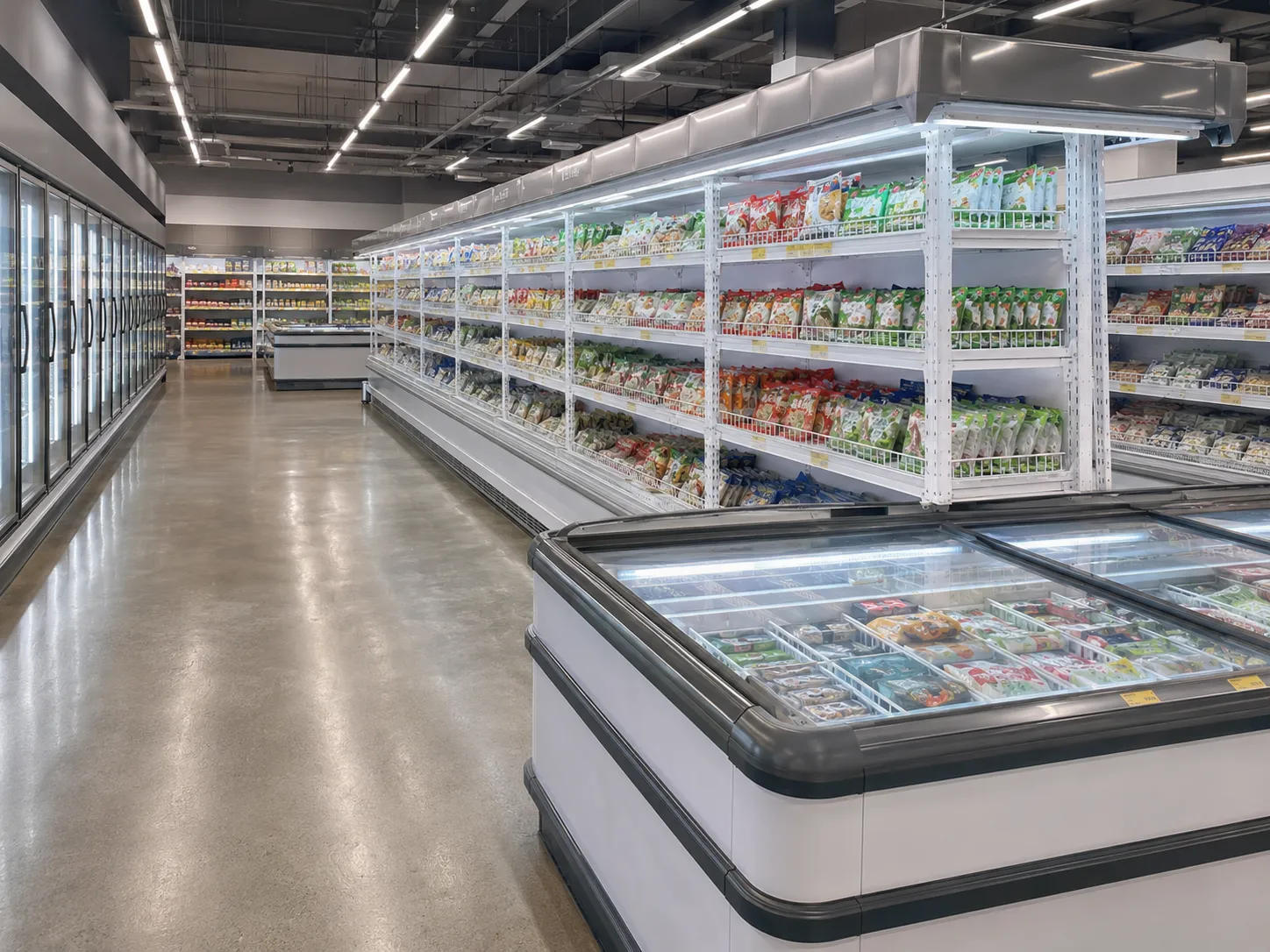
Penang Cold-Chain Frozen Food Supermarket
Project Overview
The cold-chain retail sector in Malaysia is currently navigating a significant technological upgrade as consumer demand for high-quality frozen and chilled products continues to soar. For major grocery chains, the performance of their “back-of-house” and “customer-facing” cold storage infrastructure is a primary driver of both food safety and operational profitability. The Seaside Grocery project in Penang represents a landmark achievement in specialized retail engineering. Runda Rack was tasked with designing a shelving ecosystem that could withstand the extreme moisture and sub-zero temperatures of a high-volume frozen food supermarket. By deploying a proprietary Galvanized-Epoxy Hybrid System and optimizing the structural layout for maximum air circulation, we enabled Seaside Grocery to achieve an 8% increase in chiller efficiency and a projected fixture lifespan of 15 years. This case study details the material science and structural precision required to solve the chronic problem of oxidation and structural failure in tropical cold-chain environments.
The Client & Market Context
Seaside Grocery is a premier Malaysian supermarket chain with a strong presence in coastal regions like Penang, where high ambient humidity and salt-laden air introduce unique challenges for metal infrastructure. Their strategy for the Penang flagship was to expand their “Fresh & Frozen” department by 40%, requiring a massive investment in new chiller and freezer displays. The Malaysian retail market is characterized by strict food safety regulations (HALAL and MeSTI), where any sign of rust or surface degradation on retail fixtures can lead to immediate compliance failures and store closures. Traditionally, Seaside Grocery had relied on standard powder-coated shelving which, in the high-moisture frozen zones, would begin to show signs of oxidation within 12 to 18 months. The client needed a partner who could provide a “permanent” solution that balanced extreme durability with the clean, hygienic aesthetic required for a modern grocery environment.
The Challenge (Technical & Operational)
The Seaside Grocery project presented a series of complex technical challenges rooted in the physics of thermodynamics and material science.
First, the Accelerated Oxidation and Rusting caused by constant condensation was the most significant hurdle. In a frozen food environment, shelving units are subjected to “Thermal Shock” as they move between the cold interior and the humid ambient air during stocking and cleaning. This leads to moisture entrapment under standard paint layers, causing rapid sub-surface corrosion. Standard shelving was failing not only aesthetically but also structurally, as the rust compromised the integrity of the shelf brackets.
Second, the requirement for Structural Ductility at -20 degrees Celsius was critical. Most standard carbon steels become brittle in extreme cold, making them prone to cracking under the impact of heavy frozen pallets or the vibration of chiller compressors. The shelving needed to maintain its structural flexibility to ensure the safety of both staff and customers.
Third, the conflict between Storage Density and Airflow was a major operational bottleneck. To maintain a consistent -20 degree Celsius environment, air must circulate freely around the stored products. Traditional solid shelves act as barriers to airflow, creating “hot spots” that can compromise food safety and force the refrigeration system to work harder, significantly increasing energy costs.
Finally, Hygiene and Sanitization were non-negotiable. The shelving surface needed to be non-porous and resistant to the aggressive medical-grade cleaning agents used in food environments. Any “hidden” areas or joints where food particles could accumulate would represent a major bio-hazard in a high-traffic supermarket.
The Engineering Solution
Runda Rack’s engineering team developed a comprehensive Anti-Corrosion Cold-Chain Ecosystem, utilizing our specialized material treatments and structural designs.
Galvanized-Epoxy Hybrid Coating: To solve the oxidation problem, we implemented a dual-layer protection strategy. Every component was first subjected to a “Hot-Dip Galvanization” process, providing a thick, metallurgical bond of zinc that protects the steel even if the surface is scratched. We then applied a secondary layer of “High-Density Epoxy Powder Coating.” This epoxy layer is specifically formulated for low-temperature environments, maintaining its adhesion and flexibility without “shattering” in sub-zero conditions. This hybrid approach provides a 300% increase in corrosion resistance compared to standard retail finishes.
“Air-Flow” Wire-Mesh Tiering: We replaced standard solid shelves with high-tensile “V-Ribbed” wire mesh tiers. These tiers were engineered to support loads of up to 100kg while allowing 85% of the surface area to remain open. This design facilitates vertical “Laminar Airflow” within the chiller units, ensuring that cold air penetrates even the deepest reaches of the shelving. This structural choice was the primary driver of the 8% increase in refrigeration efficiency achieved by the store.
Low-Temp Ductile Steel (Q235-LT): We utilized a specialized grade of cold-rolled steel with reduced carbon content and added manganese, specifically rated for use at temperatures down to -30 degrees Celsius. This ensures the racking remains “tough” rather than “brittle,” allowing it to safely absorb impacts without structural failure. The uprights utilized our Nine-fold design, providing the necessary torsional rigidity to prevent sway on the often-damp floors of the frozen zone.
Integrated Hygiene Engineering: To address the sanitization requirements, we engineered “Seamless-Joint” brackets and utilized “Waterfall-Edge” mesh tiers that eliminate sharp corners and hidden crevices. All connections were made using 304-grade stainless steel hardware to prevent “galvanic corrosion” between the fasteners and the racks. The entire system was designed to be “Power-Washable,” allowing store staff to deep-clean the frozen zones in minutes without needing to disassemble the racking.
Business Impact & ROI
The implementation of the Runda Rack cold-chain system delivered immediate and measurable ROI for Seaside Grocery.
Asset Lifespan and CAPEX Optimization: The projected 15-year lifespan of the hybrid-coated shelving is more than double the industry average for frozen zones. This has allowed Seaside Grocery to significantly reduce their long-term capital expenditure, as they no longer need to replace their retail fixtures every 3-5 years.
Energy Savings: The improved airflow through the wire-mesh tiers reduced the “refrigeration load” on the store’s central compressors. This resulted in an 8% reduction in the facility’s monthly electricity bill, translating to an estimated $45,000 in annual operational savings.
Food Safety and Loss Prevention: The consistent thermal environment provided by the optimized shelving layout resulted in a 95% reduction in “thaw-related” inventory write-offs. This directly improved the department’s gross margin and ensured 100% compliance with Malaysian food safety audits.
Sales Presentation: The clean, rust-free aesthetic of the white epoxy-coated racks significantly improved the visual appeal of the frozen food department. Customer surveys showed a 25% increase in “perceived freshness” ratings, contributing to a 10% increase in category sales in the first year.
Sustainability & Future Proofing
Sustainability is a key component of the Seaside Grocery project. The reduction in energy consumption directly lowers the store’s carbon footprint, and the extended lifespan of the fixtures reduces the environmental impact associated with manufacturing and transporting replacement shelving. The Runda Rack system is also designed for future-proofing. The wire-mesh tiers are already compatible with “Smart-Weight” sensors that can track inventory levels in real-time, allowing Seaside Grocery to implement automated re-ordering for high-turnover frozen goods in the future.
The “Modular Bay” design ensures that as the frozen food market evolves — for example, towards more “ready-to-eat” chilled meals — the shelving can be easily reconfigured with different tier heights or specialized gravity-flow inserts without requiring structural modifications. This inherent flexibility protects Seaside Grocery’s capital investment and ensures that their Penang flagship will remain at the cutting edge of cold-chain retail for decades to come.
Need a Similar Solution?
Our experts are ready to design a custom display or racking system tailored to your specific goals.