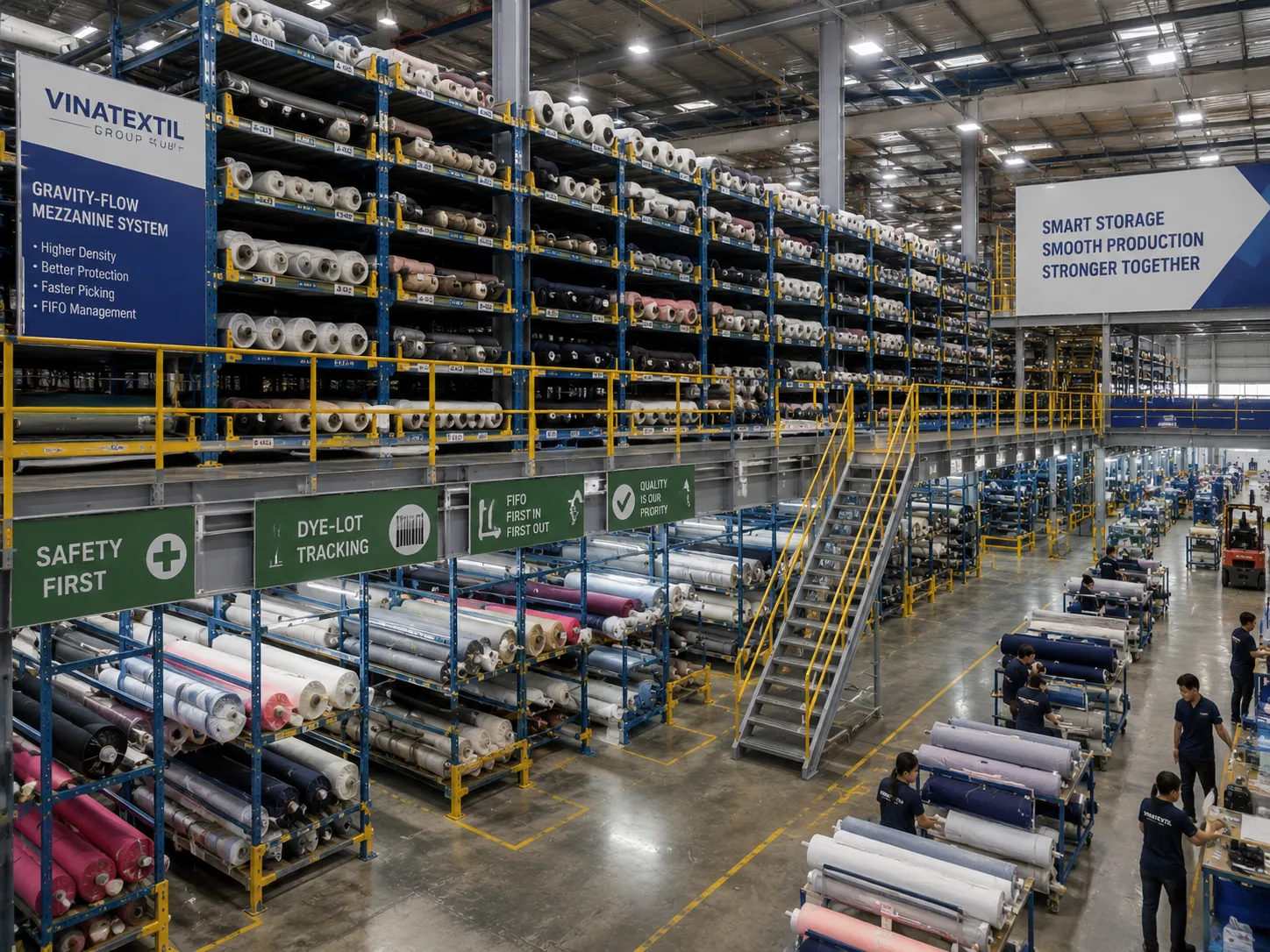
Streamlining Textile Logistics: Vina Textil Group’s Gravity-Flow Solution
Project Overview
The textile and garment industry is the backbone of Vietnam’s export economy, with Ho Chi Minh City serving as its primary manufacturing and logistical hub. As global fashion brands accelerate their production cycles to meet “Just-In-Time” (JIT) retail demands, the efficiency of raw material storage has become a critical competitive differentiator. The Vina Textil Group project represents a sophisticated engineering response to the unique physical challenges of storing high-value fabric rolls at scale. Runda Rack was commissioned to transform an inefficient, floor-stacked warehouse into a high-density, automated-flow distribution center. By integrating specialized gravity-flow lanes within a multi-tier mezzanine structure, we enabled Vina Textil to achieve unprecedented levels of inventory visibility and material protection. This case study details the technical innovations that allowed a major manufacturer to triple their storage capacity while virtually eliminating material damage.
The Client & Market Context
Vina Textil Group is a leading vertically integrated garment manufacturer, producing millions of units annually for some of the world’s most recognizable luxury and athletic brands. Their operations in Ho Chi Minh City are subject to the intense pressures of the “Fast Fashion” era, where lead times from fabric arrival to finished garment shipment are measured in days, not weeks. The Vietnamese market is currently undergoing a massive shift towards automation and high-density storage as land prices in industrial zones continue to soar and labor costs rise. Vina Textil recognized that their legacy storage methods — which relied on manual labor and floor stacking — were no longer sustainable. They needed a solution that could handle high-volume turnover, maintain the integrity of delicate materials, and optimize every square meter of their high-cost urban facility.
The Challenge (Technical & Operational)
The physical properties of textile rolls and the operational requirements of garment manufacturing introduced several high-stakes technical challenges.
First, Pressure Sensitivity was a major hurdle. Fabric rolls, especially those containing synthetic fibers or delicate dye-treated materials, are prone to “flat spotting” or “crush-loading” if stacked directly on top of each other. This physical deformation can lead to permanent creases or fiber damage, rendering the material unusable for high-end garments. Vina Textil was reporting a 4% annual loss in raw material due to improper storage.
Second, Retrieval Velocity and Dye-Lot Management were significant bottlenecks. In garment production, consistency is paramount. A single production run must use fabric from the same dye-lot to ensure color uniformity. In a floor-stacked warehouse, accessing a specific dye-lot often required moving dozens of unrelated rolls, leading to extreme delays and safety risks for workers.
Third, Weight Concentration and Safety were critical concerns. Fabric rolls are deceptively heavy, with a single high-density roll weighing up to 100kg. Floor stacking created unstable “mountains” of fabric that posed a constant risk of avalanching, especially in the high-humidity environment of Ho Chi Minh City, which can affect the friction and stability of stacked materials.
Finally, Space Underutilization was hindering growth. With 60% of their warehouse’s vertical volume being wasted, Vina Textil was on the verge of needing a costly second facility. They required a solution that could “go vertical” without sacrificing access or safety.
The Engineering Solution
Runda Rack’s engineering team developed a bespoke Textile Gravity-Flow Mezzanine System, specifically designed to address the physics of fabric storage.
Anti-Crush Dynamic Storage: We replaced the floor stacking with custom-engineered gravity-flow lanes. Each lane consists of a heavy-duty galvanized steel framework equipped with high-impact rollers. To protect the fabric, we designed specialized “U-Shaped Cradles” that attach to the pallet or directly support the roll along its entire longitudinal axis. This distributes the 100kg weight evenly, preventing point-loads that cause crushing or flat spots. The lanes are set at a precise 4-degree incline, utilizing gravity to move rolls automatically from the induction face to the picking face.
Integrated Multi-Tier Mezzanine: To maximize vertical space, the gravity lanes were integrated into a three-level mezzanine structure. This was constructed using Nine-fold upright posts and high-tensile steel beams, capable of supporting the immense cumulative weight of thousands of fabric rolls. This “building within a building” tripled the available storage area while maintaining a safe, accessible environment for staff.
Centrifugal Speed Control: Managing the momentum of heavy rolls on a gravity-fed system is a critical safety challenge. Runda Rack installed centrifugal brake rollers at regular intervals within each lane. These rollers engage automatically if a roll exceeds a safe travel speed, ensuring a controlled, constant velocity regardless of the roll’s weight or the humidity-induced friction changes.
FIFO and Dye-Lot Logic: The gravity-flow design inherently supports a First-In-First-Out (FIFO) inventory logic. Fabric rolls are loaded at the rear of the rack and picked from the front. Each lane was dedicated to a specific dye-lot or material type, and we integrated a barcode-scanning “Gate System” at each picking face. This ensures that operators can only retrieve the specific dye-lot required for the current production run, eliminating errors and streamlining the JIT workflow.
Business Impact & ROI
The transformation of Vina Textil’s logistics hub delivered a dramatic improvement in all key operational metrics.
Capacity and Space Savings: By utilizing the full vertical height of the warehouse, Vina Textil increased their storage capacity by 300% within the same footprint. This allowed them to cancel plans for a new 10,000 square meter warehouse, saving an estimated $2.5 million in capital expenditure and ongoing lease costs.
Throughput and Efficiency: Retrieval times for specific fabric lots were reduced by 70%. The automated flow of materials to the picking face meant that warehouse staff spent 25% less time searching for items and 40% less time on manual material handling. This throughput increase allowed the factory to increase its total production capacity by 15%.
Material Quality and Loss Reduction: The anti-crush engineering was a total success. Material damage rates plummeted from 4% to less than 0.1%. For a company processing $50 million in fabric annually, this reduction in waste translated into an immediate $1.95 million in annual savings.
Inventory Visibility: With every dye-lot clearly organized in its own dedicated lane, inventory accuracy improved to 99.8%. The “ghost inventory” and “lost lots” that had plagued the manual system were completely eliminated, allowing for more precise production planning and reduced over-ordering.
Sustainability & Future Proofing
The project aligns with Vina Textil’s commitment to sustainable manufacturing. By eliminating the need for a second warehouse, the company significantly reduced the carbon footprint associated with facility construction and daily logistics. The gravity-flow system itself is energy-neutral, requiring no electricity for the movement of goods.
The Runda Rack structure is also designed for future automation upgrades. The picking faces of the gravity lanes are pre-aligned with standard automated guided vehicle (AGV) heights, allowing Vina Textil to integrate robotic picking systems in the future without modifying their core racking infrastructure. The modularity of the system ensures that as fabric roll dimensions change with new textile technologies, the lane widths and roller configurations can be adjusted with minimal downtime, ensuring the facility remains at the cutting edge of textile logistics for the next 20 years.
Need a Similar Solution?
Our experts are ready to design a custom display or racking system tailored to your specific goals.