High-Density Cold Chain Excellence: Gulf Logistics Group Case Study
Project Overview
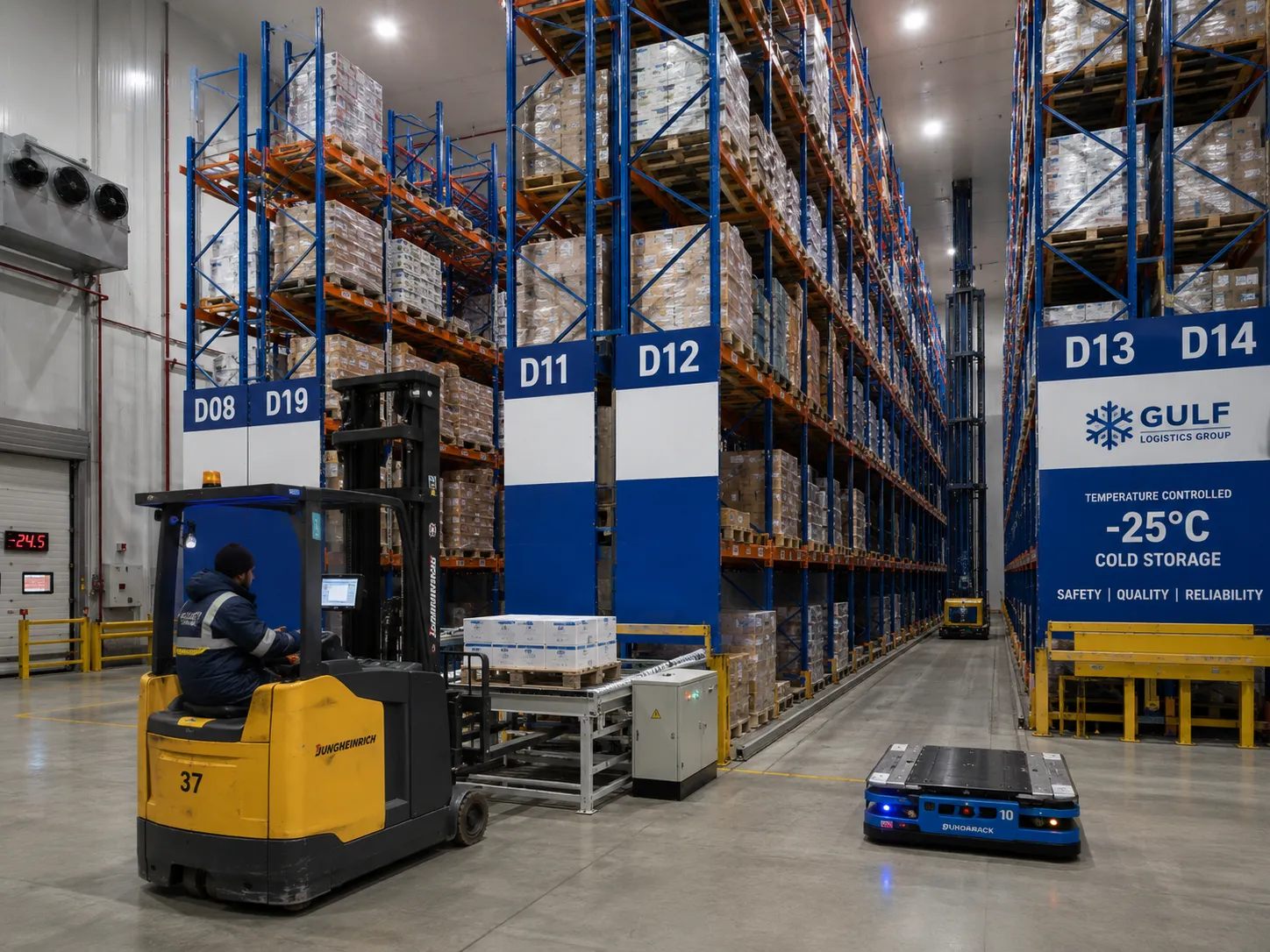
The global cold chain industry is currently navigating a period of rapid technological evolution, driven by the increasing demand for temperature-sensitive pharmaceuticals and high-quality perishable foods. Nowhere is this demand more acute than in Dubai, a global logistics pivot point connecting East and West. The Gulf Logistics Group (GLG) Cold Storage Project is a definitive example of how engineering innovation can overcome the extreme environmental and operational constraints of the Middle East. Runda Rack was tasked with designing and installing a high-density, semi-automated storage solution within GLG’s 15,000 square meter flagship facility. Operating at a constant -25 degrees Celsius, this project required a “first-principles” engineering approach to ensure structural integrity, mechanical reliability, and maximum energy efficiency. The result is one of the most technologically advanced cold storage hubs in the region, capable of managing 22,000 pallet positions with unprecedented precision.
The Client & Market Context
Gulf Logistics Group is a dominant force in the UAE’s third-party logistics (3PL) sector, specializing in the handling of high-value, temperature-controlled assets. As Dubai continues to expand its role as a global re-export hub, the demand for cold storage space has far outpaced supply. In this market, the “cost per cubic meter of cooling” is the primary driver of profitability. Real estate prices in the Jebel Ali Free Zone and surrounding logistics parks have climbed steadily, making horizontal expansion prohibitively expensive. Consequently, GLG required a partner who could maximize vertical space utilization and storage density within their existing facility footprint. The market context also mandated strict compliance with international food safety standards (HACCP) and pharmaceutical storage regulations (GDP), necessitating a racking solution that was both ultra-clean and highly organized.
The Challenge (Technical & Operational)
The Gulf Logistics project presented a set of technical challenges that would have compromised standard warehousing equipment within months of operation.
First, the Extreme Thermal Gradient was the most significant factor. At -25 degrees Celsius, standard carbon steel undergoes a transition to a “brittle” state, significantly increasing the risk of structural failure under load or impact. Furthermore, the high ambient temperatures of Dubai (often exceeding 45 degrees Celsius) during the installation phase meant that the steel would undergo significant thermal contraction once the facility was brought down to operating temperature.
Second, Energy Efficiency and Volume Optimization were critical. In a cold store, every cubic meter of “empty” air represents wasted energy. Traditional selective racking requires wide aisles for forklifts to maneuver, resulting in a low storage-to-volume ratio. GLG needed to eliminate these aisles to maximize the “thermal mass” of the stored goods, thereby stabilizing the internal temperature and reducing the load on the refrigeration units.
Third, Automation Reliability in sub-zero conditions is notoriously difficult. Standard lubricants freeze, battery life for mobile units is severely diminished, and sensors are prone to frost accumulation. The semi-automated shuttles needed to be rated for continuous 24/7 operation in the “dark store” environment without requiring frequent human intervention for maintenance or recovery.
Finally, Operational Velocity was non-negotiable. GLG manages high-turnover inventory for major retail chains. The system had to support high-throughput inbound and outbound cycles, ensuring that pallet retrieval times did not become a bottleneck in the supply chain.
The Engineering Solution
Runda Rack’s engineering team developed a comprehensive Automated Radio Shuttle (ARS) solution tailored specifically for the GLG facility.
Structural Engineering: We utilized specialized Q345B Low-Temperature Alloy Steel for the entire racking structure. This steel is enriched with specific alloying elements that maintain ductility and impact resistance even at -40 degrees Celsius. To address the thermal contraction issue, we engineered “sliding joints” into the base plates and rail connectors, allowing the structure to contract safely by several centimeters without introducing internal stresses that could lead to buckling. The surface was treated with a high-micrometer electrostatic powder coating specifically formulated for high-humidity, low-temperature transitions to prevent sub-surface oxidation.
High-Density Shuttle Technology: The heart of the system is the Runda Radio Shuttle. This semi-automated unit travels on rails within the storage lanes, carrying pallets from the picking face to the deepest reaches of the rack. By utilizing this technology, we were able to implement a “Deep-Lane” storage strategy (up to 20 pallets deep). This eliminated the need for internal forklift aisles, allowing the racking to occupy over 85% of the warehouse’s floor area. The shuttles are powered by high-capacity Lithium Iron Phosphate (LiFePO4) batteries with integrated thermal management systems, ensuring consistent power delivery even in the -25 degree Celsius environment.
Airflow and Thermal Dynamics: Working with GLG’s refrigeration engineers, we designed the racking layout to facilitate “Laminar Airflow.” The horizontal and vertical gaps between pallets were precisely calculated to ensure that cold air could circulate evenly around every pallet position. This eliminated “dead zones” where temperature fluctuations could occur, ensuring that the most sensitive pharmaceutical products remained within their specified thermal window.
Safety and Recovery Systems: Given the difficulty of human entry into a -25 degree store, we installed a comprehensive array of safety and recovery features. Every shuttle lane is equipped with laser-based end-of-rail buffers and anti-collision sensors. We also provided a “Remote Recovery Vehicle” — a secondary shuttle capable of docking with a stalled unit and towing it back to the picking face for servicing, thereby ensuring zero operational downtime in the event of a mechanical fault.
Business Impact & ROI
The implementation of the Runda Rack ARS system delivered immediate and measurable ROI for Gulf Logistics Group.
Capacity Increase: Storage density increased by 50% compared to the client’s previous selective racking designs. The facility was able to accommodate 22,000 pallets in a footprint that would normally only hold 14,000, effectively adding 8,000 “virtual” pallet positions without expanding the building.
Energy Savings: By maximizing the density of the stored goods, the facility’s “thermal inertia” was significantly increased. This allowed the refrigeration system to operate 20% more efficiently, resulting in an annual energy cost saving of approximately $180,000.
Labor Efficiency and Throughput: The semi-automated nature of the shuttle system allowed GLG to reduce their forklift fleet by 40%. Forklift operators no longer need to enter the cold store aisles, which reduced heat ingress and improved operator safety. Pallet retrieval speeds increased by 35%, enabling GLG to meet the aggressive delivery windows required by their high-volume retail clients.
Loss Prevention: The precision of the ARS system significantly reduced pallet damage. In traditional deep-storage systems like Drive-In racking, forklift impacts are a common cause of damage to both the racking and the products. With the shuttle system, all pallet movements are automated and controlled, resulting in a 95% reduction in rack-related product loss.
Sustainability & Future Proofing
Sustainability is a core component of the GLG project. The reduction in energy consumption directly lowers the facility’s carbon footprint, a key requirement for GLG’s corporate social responsibility targets. The Runda Rack system is also designed for long-term scalability. The “Shuttle-Ready” rails are compatible with next-generation fully autonomous shuttles, allowing GLG to transition to a completely “lights-out” automated warehouse in the future without replacing their existing racking infrastructure.
Furthermore, the modular design of the ARS system allows GLG to easily reconfigure the storage lanes if their pallet dimensions change in the future. This flexibility, combined with the extreme durability of the low-temperature certified steel, ensures that the GLG Cold Storage Hub will remain a highly profitable and efficient asset for at least the next 20 years.
Need a Similar Solution?
Our experts are ready to design a custom display or racking system tailored to your specific goals.